 88222 82888

House Construction Cost in Gujarat: How to Plan and Save Without Cutting Corners
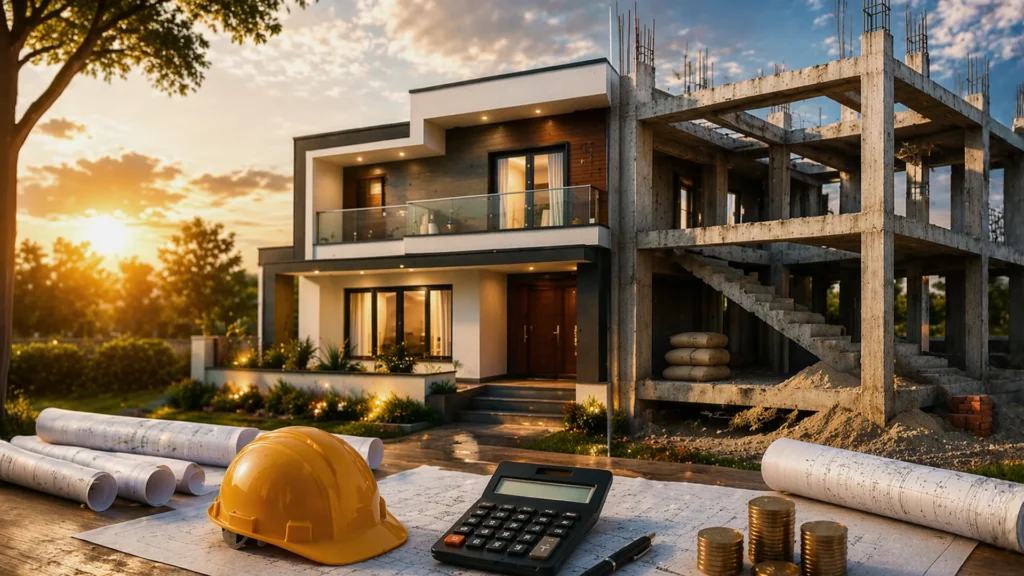
Building a home is a lifelong dream for many, but with today’s inflation and rapidly changing material prices, estimating the true cost has become challenging for anyone planning a home in Gujarat in 2026. House construction costs have shifted considerably from what most estimates were even two years ago.
In Gujarat, house construction costs vary widely depending on several key factors such as location, material choices, and labour conditions.
Keeping up with current market rates is essential, as material prices have shifted and labour costs have risen. Yet, many families are still planning their home budgets based on outdated assumptions, leaving them with unexpected overruns.
This guide will help you understand what things actually cost, how to plan realistically, and most importantly, how to save money without sacrificing the structural integrity of your home.
What House Construction Costs in Gujarat in 2026
House construction costs in Gujarat currently range from approximately ₹1,600 to ₹3,000 per square foot, and the variation depends on material quality, construction method, and city. The state average for a mid-range residential project sits close to ₹1,850 per sq ft, which is consistent with broader national trends where costs range between ₹1,600 and ₹3,200 per sq ft across India in 2026.
But these are averages. The reality varies meaningfully by city:
- Ahmedabad: ₹1,900-₹2,800 per sq ft (higher due to land premiums and premium contractor demand)
- Surat: ₹1,750-₹2,600 per sq ft (active construction market, moderate labour availability)
- Vadodara: ₹1,650-₹2,400 per sq ft (slightly lower costs but trending upward)
- Tier 2 towns (Rajkot, Anand, Mehsana): ₹1,500-₹2,000 per sq ft
Steel prices have been a significant pressure point in 2026. TMT steel, a backbone of RCC construction, saw a 6-9% increase in the first quarter of 2026 due to global supply chain adjustments and domestic demand from infrastructure projects.
This has pushed civil construction budgets upward, even where other material costs have remained relatively stable.
Cement prices in Gujarat have seen moderate movement, averaging between ₹350-₹420 per 50 kg bag depending on brand and grade, and this range has a direct bearing on both construction cost and long-term structural performance.
How House Construction Costs Are Divided
Understanding the cost structure of house construction helps you make smarter decisions at every stage. Here is an approximate breakdown for a mid-range residential project in Gujarat:
Component
Approximate Share of Total Cost
Civil and Structural Work
25–30%
Materials (cement, steel, bricks, aggregates)
30–35%
Labour
20–25%
Finishing (flooring, plastering, paint, tiles)
15–20%
Electrical, Plumbing, and Sanitation
8–12%
Contingency
5–10%
The materials category deserves special attention. Within it, cement and steel together account for roughly 15–20% of the total project cost. And within cement, specifically, the cement quality you choose shapes everything downstream: the strength of your columns, the durability of your slabs, and how much you will spend on maintenance over the next 20 years.
A contractor saving ₹15 per bag by switching to a lower-grade cement across 500 bags saves you ₹7,500. But if that choice leads to surface cracking, water seepage, or structural weakness within 5 years, the repair cost can run into lakhs. That maths does not work in your favour.
How to Plan Your House Construction Budget
01
Calculate Your Built-Up Area Accurately
Before approaching any contractor or architect, calculate your built-up area clearly and precisely. A 1,500 sq ft house at ₹2,000 per sq ft is a ₹30 lakh project. At ₹2,400 per sq ft with better finishing, it becomes ₹36 lakhs. That ₹6 lakh difference needs to exist in your planning, not surface as a surprise later.
Decide your quality tier at this stage. Basic, mid-range, and premium construction each carry different material requirements, and cement quality is one of the first things that varies between them.
02
Choose the Right Contract Type
This decision has significant financial consequences.
Labour contract: You procure all materials independently, which gives you full visibility into what is being used and at what cost. This approach can deliver savings of 10–15% if you are actively involved, but it requires time, knowledge, and vendor management on your part.
Turnkey contract: The contractor handles all procurement and execution. This is more convenient, but contractor margins are embedded in material costs, so transparency in billing matters. Always ask for itemised invoices.
A practical middle path for most homeowners is to use a turnkey arrangement for structural work while self-procuring finishing materials like tiles, fixtures, and paint, where the choices are more visible and easier to compare.
03
Build a 15% Buffer Into Every Estimate
How to Save Money Without Compromising Your Home
01
Design Efficiency Reduces Cost Before a Single Bag Is Opened
02
Finishing Materials Offer Room to Save
03
Cement Quality Is Not an Area for Cost Reduction
The structural elements of any home, such as footings, columns, beams, and slabs, depend on cement that meets the correct grade specification and performs consistently across batches. In Gujarat’s climate, where summer temperatures exceed 45°C, and monsoon moisture levels are significant, the performance demands on structural cement are real. Using a lower-grade cement in these applications to save ₹10-15 per bag across a few hundred bags produces a short-term saving that is routinely overtaken by long-term repair requirements.
For structural applications, BIS-certified OPC 53 grade or PPC from a reliable manufacturer is the appropriate choice. Like Vasuki Cement, which maintains strict quality control across OPC, PPC, and PSC grades at its Gujarat-based plant, ensuring uniform performance from foundation to slab and cement quality at this stage should be treated as a fixed requirement, not a variable
04
Bulk Purchasing and Vendor Scheduling
05
Preventing Rework Is the Most Effective Cost Control
Why Cement Quality Is a Long-Term Investment
Cement quality affects three things that matter to every homeowner over time.
Structural strength: Compressive strength determines how columns and beams carry load across decades. A cement that meets its rated grade and is properly mixed and cured will maintain its structural contribution through the life of the building. One that does not will begin showing stress earlier than the design intended.
Durability in Gujarat’s conditions: The state presents a demanding environment for construction materials. High summer temperatures, seismic risk in Kutch and Saurashtra zones, and significant monsoon moisture all place real demands on structural concrete. Good cement quality combined with correct water-cement ratios and proper curing reduces carbonation, limits chloride ingress, and protects reinforcement from corrosion over time.
Maintenance cost across the building’s life: Homes built with structurally sound cement and correct construction practices typically require minimal structural maintenance for the first 20-25 years. Where cement quality was reduced to save on initial cost, surface cracking tends to appear within 3-5 years, seepage within 7-10 years, and remedial structural work within 15 years. The cost of that remedial work is consistently higher than what the savings on cement amounted to.
Treating cement quality as a long-term investment rather than a procurement line item is the decision that separates a low-maintenance home from one that requires recurring intervention.
Common Mistakes Gujarat Homeowners Make
Underestimating total project cost: Many homeowners budget for house construction cost alone and exclude site preparation, approvals, compound walls, water and electricity connection, and interior work. The total outlay on a residential project is typically 25–30% higher than the bare construction figure.
Accepting the lowest quote without scrutiny: The lowest contractor quote almost always involves compromises in material quality, labour experience, or scope, and those compromises surface later as additional charges or rework. Always compare at least three detailed quotations with itemised breakdowns.
Skipping soil testing: Gujarat has varied soil conditions across regions, and expansive black cotton soil in certain areas requires deeper foundations than standard specifications assume. A soil test costs between ₹5,000 and ₹15,000 and is one of the most consequential investments at the start of any project.
Not accounting for material price movement: A project spanning 12-18 months will experience material cost changes and steel and cement prices, in particular respond to policy decisions, monsoon seasons, and commodity markets. Where possible, lock in rates and factor potential escalation into your budget from the start.
Insufficient site supervision: Delegation without oversight leads to diluted concrete mixes, reduced reinforcement cover, and workmanship that does not match specification. Visiting the site at every critical structural stage and asking for materials to be documented before use is a basic practice that protects the investment.
Final Thoughts
House construction in Gujarat in 2026 requires planning that is grounded in current cost realities, structured in advance, and guided by an understanding of where quality matters and where it does not. The decisions made in the planning phase, on contract type, material specification, supervision, and contingency, determine how well the finished home performs for the next 40-50 years.
Meaningful savings are available through smarter design, efficient procurement, and well-structured contracts. But structural material quality, and cement quality in particular, is where savings carry consequences that extend well beyond the construction period. A home built once on the right foundation, with the right materials, is the most cost-effective outcome any homeowner can plan for.
FAQs
What is the house construction cost in Gujarat in 2026?
How much does cement cost per bag in Gujarat in 2026?
What percentage of house construction cost goes to materials in Gujarat?
How long does it take to build a house in Gujarat?
Is it cheaper to build or buy a house in Gujarat?
Looking for Cement Supply or Dealership?
Partner with us for consistent quality, competitive pricing, and dependable delivery.
Looking for Cement Supply or Dealership?
Partner with us for consistent quality, competitive pricing, and dependable delivery.