 88222 82888

Are AAC Blocks Right for Your Home? Here's How to Decide
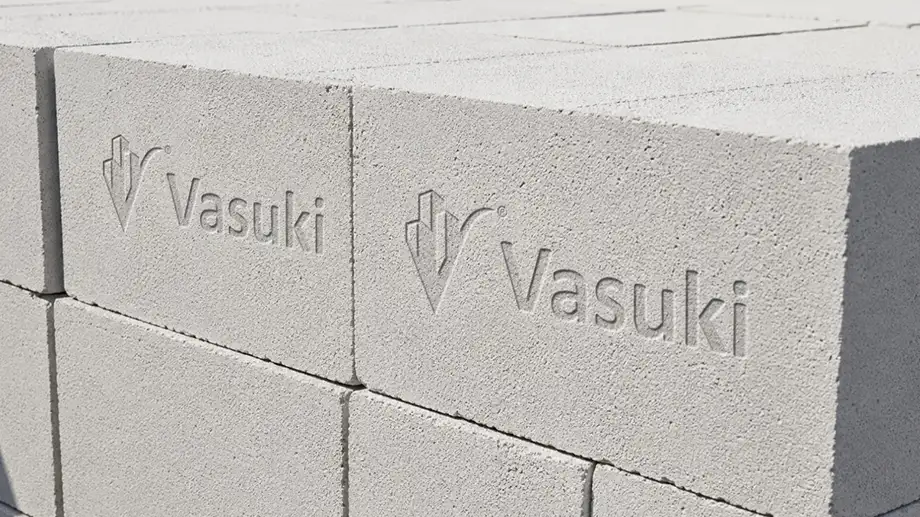
Most homeowners compare AAC blocks to red bricks by price alone. An AAC block costs Rs. 25-45 in Gujarat. A red brick costs only Rs. 4-7. So AAC looks expensive at first glance. But that comparison is misleading, because one block replaces 8-12 bricks. Once you count the whole wall, not just one piece, the picture changes.
So what are these blocks made of? AAC blocks, or Autoclaved Aerated Concrete blocks, are lightweight blocks made from fly ash, cement, lime, gypsum, and a small amount of aluminium powder. That powder creates millions of tiny air bubbles inside. The blocks then bake under heat and pressure. As a result, they come out 50-70% lighter than red clay brick, with better heat insulation, sound blocking, and fire resistance. Every block also meets the IS 2185 Part 3 standard set by the Bureau of Indian Standards.
This guide walks through what these blocks are made of, how they compare to brick, which size to use for each wall, how to install them correctly, and a simple 5-question test to check if they suit your home.
What AAC Blocks Are Made Of
Manufacturers mix fly ash, cement, lime, and gypsum with a small amount of aluminium powder. This powder reacts and releases hydrogen gas. As a result, the mix puffs up to roughly five times its size. Workers cut it into blocks and cure them in a pressure oven called an autoclave, at about 190 degrees Celsius. This gives each block a density of 550-650 kg/m3, against red brick’s 1,800-2,000 kg/m3, which explains why they weigh so much less.
The Bureau of Indian Standards sets the rules under IS 2185 Part 3, covering minimum strength, size accuracy, and density. So before you buy, check for the BIS licence number and the ISI mark on the packaging. Vasuki Cement supplies high-quality AAC Blocks built to this exact standard.
Seven Reasons AAC Blocks Save You Money and Add Comfort
- Better insulation: they let through 4-6 times less heat than red brick. So rooms stay cooler in Gujarat’s summer heat.
- Lighter weight: 50-70% less than brick. Because of this, engineers can use smaller columns and shallower foundations, which often balances out the higher block price.
- Faster construction: a mason lays 20-25 sq m a day, versus 12-15 sq m with brick. This is because one block covers 8-12 bricks’ worth of area.
- Stronger fire safety: 4-hour fire resistance versus only 1-2 hours for red brick.
- Better sound blocking: a 200 mm wall scores STC 44, which is higher than a 230 mm brick wall.
- Better for the environment: made from fly ash instead of burning topsoil. Also eligible for GreenPro Ecolabel certification under GRIHA.
- Less mortar needed: thin joints and larger units together cut mortar use by 66% per square metre.
Four Limitations You Should Know Before Deciding
- Lower load capacity: AAC blocks handle 3.5-6 MPa, which suits filling walls in an RCC frame but is less than dense concrete blocks (7-15 MPa), so they should not carry structural load alone.
- Higher price per piece: Rs. 25-45 versus Rs. 4-7 for a brick, in Gujarat’s Tier-2 cities (AECORD, 2026). This still matters for tight budgets, even where total wall cost favours it.
- Skilled labour required: so thin-bed mortar work costs 20-30% more in labour, and workers new to the material often get the joint thickness wrong.
- Not for damp areas: the porous structure soaks up ground moisture over time. So always use regular masonry below the damp-proof course, and this material above it.
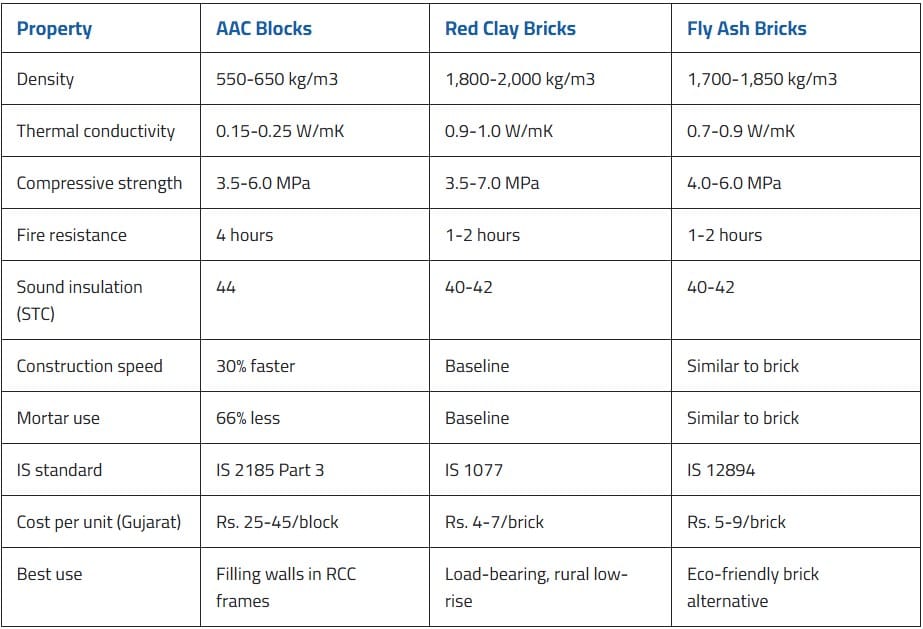
AAC Blocks vs Red Bricks vs Fly Ash Bricks
| Property | AAC Blocks | Red Clay Bricks | Fly Ash Bricks |
|---|---|---|---|
| Density | 550-650 kg/m3 | 1,800-2,000 kg/m3 | 1,700-1,850 kg/m3 |
| Thermal conductivity | 0.15-0.25 W/mK | 0.9-1.0 W/mK | 0.7-0.9 W/mK |
| Compressive strength | 3.5-6.0 MPa | 3.5-7.0 MPa | 4.0-6.0 MPa |
| Fire resistance | 4 hours | 1-2 hours | 1-2 hours |
| Sound insulation (STC) | 44 | 40-42 | 40-42 |
| Construction speed | 30% faster | Baseline | Similar to brick |
| Mortar use | 66% less | Baseline | Similar to brick |
| IS standard | IS 2185 Part 3 | IS 1077 | IS 12894 |
| Cost per unit (Gujarat) | Rs. 25-45/block | Rs. 4-7/brick | Rs. 5-9/brick |
| Best use | Filling walls in RCC frames | Load-bearing, rural low-rise | Eco-friendly brick alternative |
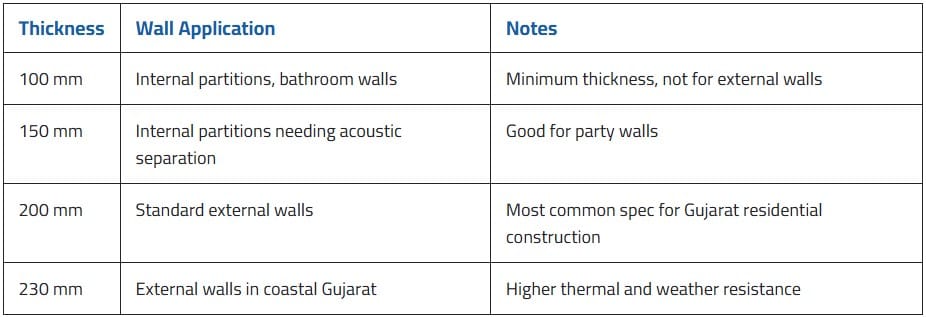
Which AAC Block Size to Use for Each Wall
| Thickness | Wall Application | Notes |
|---|---|---|
| 100 mm | Internal partitions, bathroom walls | Minimum thickness, not for external walls |
| 150 mm | Internal partitions needing acoustic separation | Good for party walls |
| 200 mm | Standard external walls | Most common spec for Gujarat residential construction |
| 230 mm | External walls in coastal Gujarat | Higher thermal and weather resistance |
How to Install AAC Blocks the Right Way
AAC blocks need thin mortar joints, only 2-3 mm thick. Regular brick mortar runs 10-12 mm, far too thick here. If your mason uses thick joints, you lose the mortar saving. Worse, the surface turns out less flat, and heat starts leaking through the thick joints instead of staying blocked.
- First, lay one thick mortar course at the base, at DPC level, to level out any unevenness in the frame. This is the only thick joint in the whole wall.
- Next, set the corner blocks first, check level and plumb, then cut extra blocks to the nearest 50 mm size.
- Then spread thin-bed adhesive with a notched trowel, keeping it at 2-3 mm throughout.
- Also check level every 2-3 blocks, and tap each one gently into place without sliding, since the adhesive grips fast.
- Finally, add reinforcing mesh every 600 mm for walls longer than 4 m or taller than 3 m, a step many new contractors skip.
Finish both wall faces with a plaster made specially for this surface, since regular plaster shrinks and cracks on it. PPC cement works well as the base for both the mortar and the plaster coat.
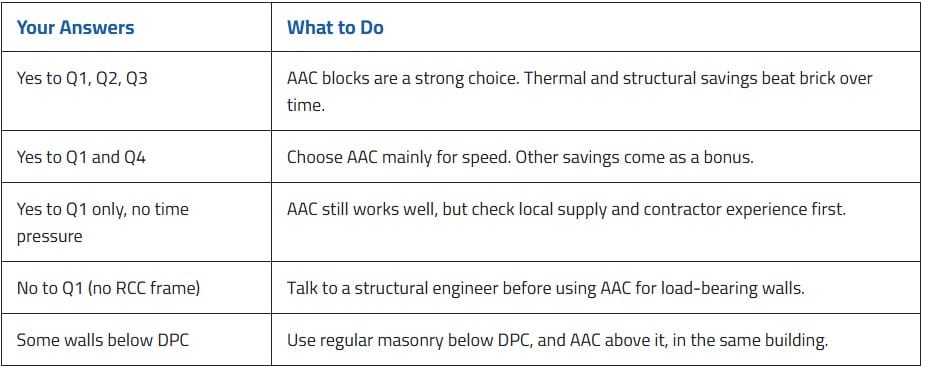
A Simple 5-Question Test for Your Home
Answer these five questions honestly for a clear answer on whether AAC blocks suit your project.
- Does your building have an RCC frame? If yes, AAC blocks work well as filling walls, their main use across India. If no, talk to a structural engineer first.
- Do summers in your area cross 40 degrees Celsius, like in Gujarat? If yes, the insulation advantage saves real money on cooling.
- Is your building G+2 or taller? Taller buildings gain more from the 50-70% weight reduction, through smaller columns and lighter foundations.
- Does your construction timeline matter commercially? A 30% speed advantage carries direct value against a deadline.
- Is your entire site above the damp-proof course? If any part sits below it, use regular masonry there instead.
| Your Answers | What to Do |
|---|---|
| Yes to Q1, Q2, Q3 | AAC blocks are a strong choice. Thermal and structural savings beat brick over time. |
| Yes to Q1 and Q4 | Choose AAC mainly for speed. Other savings come as a bonus. |
| Yes to Q1 only, no time pressure | AAC still works well, but check local supply and contractor experience first. |
| No to Q1 (no RCC frame) | Talk to a structural engineer before using AAC for load-bearing walls. |
| Some walls below DPC | Use regular masonry below DPC, and AAC above it, in the same building. |
What This Saves You in Gujarat's Heat
Picture a 1,500 sq ft home in Ahmedabad, built with red brick. It might cost Rs. 3,000-4,000 a month to cool during April to June. Better insulation can cut that bill by 25-35%, roughly Rs. 750-1,400 saved a month, or Rs. 4,500-8,400 across one summer. That saving repeats every year the house stands.
The market reflects this shift too. India’s AAC blocks market reached USD 4.0 billion in 2025 and should hit USD 9.1 billion by 2034, growing 9.5% a year (IMARC Group). India still makes around 250 billion red clay bricks a year, so plenty of room remains for growth. Gujarat leads this shift in western India, thanks to Morbi’s manufacturing base and red brick restrictions in several districts.
The Right Choice Depends on Your Project
AAC blocks work best for most modern homes built on an RCC frame in Gujarat. The taller the building, or the hotter the summers, the stronger the case becomes. Red brick still makes sense for load-bearing walls without an RCC frame, tight budgets, or areas where supply or skilled labour is hard to find. Run your project through the 5-question test above, pick the right size for each wall, and confirm your contractor understands the thin-bed mortar rule before work begins.
For a wider look at how AAC blocks fit alongside cement and TMT, see the full building construction materials guide.
Buy AAC Blocks From a Trusted Gujarat Manufacturer
Buy AAC Blocks From a Trusted Gujarat Manufacturer Vasuki Cement supplies AAC blocks for homes and commercial projects across Gujarat, built to IS 2185 Part 3 at its Morbi facility. Reach out to check pricing and availability for your project.
Call: 88222 82888
Email: sales@vasukiinfra.com
Website: vasukiinfra.com/contact-us
FAQs
What are AAC blocks?
Are they better than red bricks for a home in Gujarat?
What are the disadvantages?
Which size should I use for external walls?
Do they need special mortar?
Where can I buy them in Gujarat?
Looking for Cement Supply or Dealership?
Partner with us for consistent quality, competitive pricing, and dependable delivery.
Looking for Cement Supply or Dealership?
Partner with us for consistent quality, competitive pricing, and dependable delivery.