 88222 82888

Cement Grade Explained - Types, Strength, and Applications
Every bag of cement carries a number 33, 43, or 53 that many buyers see but may not fully understand. This number is not a batch code or a brand variant. It refers to the minimum compressive strength the cement is required to achieve after 28 days of curing.
Understanding cement grade helps you choose the right cement for the job instead of simply choosing the highest number. From residential slabs and columns to plastering, foundations, and large infrastructure projects, the appropriate grade depends on the application, structural requirements, and project conditions.
In this guide, we explain what the grade of cement means, the different grades of OPC, how PPC, PSC, and GGBS differ, how cement grade compares with concrete grade, and how to verify cement quality before buying.
What Cement Grade Actually Means
Cement grade refers to the minimum compressive strength that cement achieves after 28 days of standard curing. This strength is measured in megapascals (MPa), which is equivalent to N/mm².
A higher number indicates higher specified compressive strength. However, a higher cement grade does not automatically mean better cement for every application. The right choice depends on the construction requirement.
In India, cement standards are governed by the Bureau of Indian Standards (BIS). Ordinary Portland Cement (OPC) is available in three standard grades: 33, 43, and 53, each covered by its relevant Indian Standard (IS) specification.
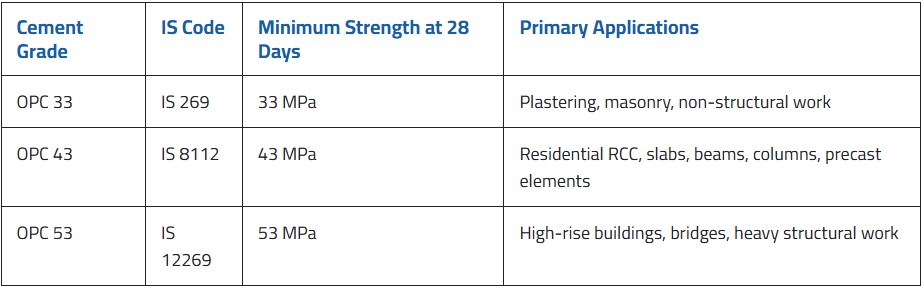
The Three OPC Grades: IS Codes, Strength, and Applications
| Cement Grade | IS Code | Minimum Strength at 28 Days | Primary Applications |
|---|---|---|---|
| OPC 33 | IS 269 | 33 MPa | Plastering, masonry, non-structural work |
| OPC 43 | IS 8112 | 43 MPa | Residential RCC, slabs, beams, columns, precast elements |
| OPC 53 | IS 12269 | 53 MPa | High-rise buildings, bridges, heavy structural work |
01
OPC 33 : Legacy Grade, Limited Modern Use
OPC 33 is the lowest of the three standard OPC grades, with a minimum 28-day compressive strength of 33 MPa. It can be used for plastering, masonry, and other non-structural applications.
However, its use in modern construction is limited, with OPC 43 generally preferred where higher strength is required.
02
OPC 43 : A Common Choice for Residential Construction
OPC 43 provides a balance of strength, workability, and practical performance, making it a common choice for standard residential construction.
It can be used in RCC applications such as slabs, beams, and columns, depending on the structural design and engineer’s specification. A specialised OPC 43-S variant is also used for railway sleepers and should not be confused with the standard residential application.
03
OPC 53 : High Strength and Faster Early Strength Gain
OPC 53 has a minimum 28-day compressive strength of 53 MPa and generally develops strength faster at early ages than lower-grade OPC.
It is commonly used where higher early strength is required, including high-rise buildings, bridges, heavy industrial structures, and projects where faster formwork removal is important.
However, higher strength does not mean it should be used everywhere. OPC 53 can generate more heat of hydration, so large concrete pours require appropriate mix design and curing practices to manage the risk of thermal cracking.
PPC, PSC, and GGBS: Why They Are Not “Graded” Like OPC
01
PPC - Portland Pozzolana Cement
PPC is covered under IS 1489 and is classified based on its composition rather than the numerical OPC grading system. It incorporates pozzolanic material such as fly ash and generally develops strength differently from OPC.
PPC is widely used for general construction, plastering, and applications where lower heat of hydration can be beneficial.
02
PSC - Portland Slag Cement
PSC is covered under IS 455 and incorporates blast-furnace slag. It offers properties that can make it suitable for environments where resistance to sulphates and chlorides is important.
For this reason, PSC is often considered for foundations, coastal construction, marine environments, and other projects exposed to aggressive conditions.
03
GGBS - Ground Granulated Blast-furnace Slag
GGBS is covered under IS 16714 and is used as a supplementary cementitious material rather than being treated like OPC 33, 43, or 53.
GGBS can be used in blends with cement to improve durability, reduce permeability, and contribute to long-term strength development. It is particularly relevant for durability-critical foundations and large-volume concrete pours where controlling heat generation is important.
Cement Grade vs Concrete Grade: The Confusion That Trips Up Homeowners
One of the most important distinctions to understand is the difference between cement grade and concrete grade.
| Cement Grade | Concrete Grade |
|---|---|
| Describes the strength of cement | Describes the strength of the final concrete |
| Examples: 33, 43, 53 | Examples: M15, M20, M25, M30 |
| Applies to the cement material | Applies to the complete concrete mix |
| Influenced by the cement's properties | Depends on mix design, cement, aggregates, water, and other factors |
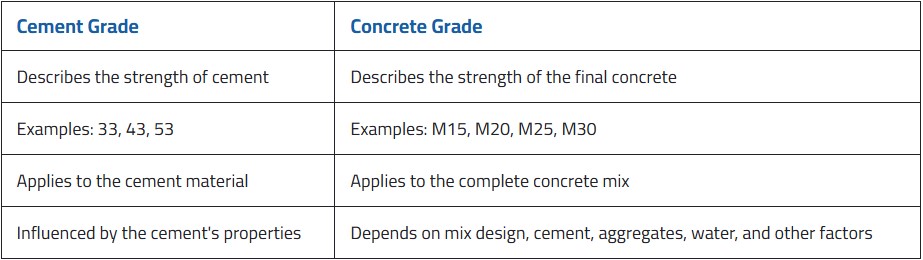
For example, OPC 43 cement can be used to produce M20, M25, or higher concrete grades, depending on the mix design and quality of the other materials.
So, if a structural drawing specifies M20 concrete, it is not directly telling you to buy “M20 cement.” It is specifying the required strength of the finished concrete. The appropriate cement and mix proportions should be selected accordingly.
How to Choose the Right Cement Grade for Your Project
The right grade of cement depends on what you are building and the conditions the structure will face.
| Application | Recommended Grade/Type |
|---|---|
| Plastering and finishing | PPC or OPC 43 |
| Masonry and brickwork | OPC 43 or PPC |
| Residential RCC: slabs, columns, beams | OPC 43 |
| High-rise or heavy structural work | OPC 53 |
| Coastal or sulphate-exposed foundations | PSC or GGBS-blended cement |
| Mass concrete or large-volume pours | PPC or GGBS blend |
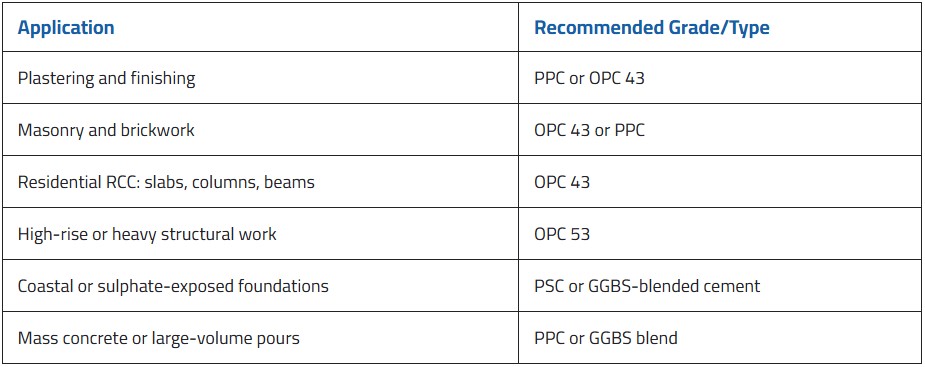
These are general application guidelines, not a substitute for a structural engineer’s specification.
Most importantly, do not automatically choose the highest grade for every application. Using OPC 53 for plastering or routine masonry may add cost without providing a meaningful advantage. The cement should match the actual technical requirement of the work.
The 28-Day Rule and Why Curing Timeline Matters
The number printed on OPC cement refers to its specified compressive strength at 28 days under standard testing conditions. Concrete and cement continue developing strength beyond this point, but 28 days is the standard reference age for grading.
| Curing Stage | Approximate Strength Development |
|---|---|
| 3 days | 30-40% of rated strength |
| 7 days | 65-70% |
| 28 days | 100% of rated grade strength |
| 90 days | Can exceed 28-day rated strength |
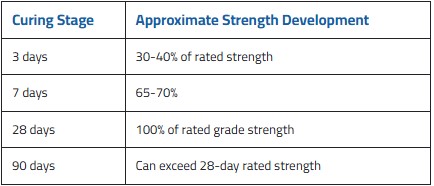
Actual strength development varies with cement composition, mix conditions, temperature, curing, and other factors.
This is why curing matters. Even correctly graded cement can underperform if the material is exposed to inadequate moisture, unsuitable temperatures, or poor curing practices.
How to Verify Cement Grade and Quality Before Buying
Knowing the different cement grades is only useful if you can verify what you are purchasing. Before buying cement, check:
- Grade or cement type: Confirm that the bag clearly identifies OPC 33, OPC 43, OPC 53, PPC, PSC, or the specified product.
- BIS/ISI marking: Look for the relevant BIS/ISI certification and applicable IS standard.
- Manufacturing date: Check how recently the cement was manufactured. Fresh cement is generally preferred, as cement can lose performance during prolonged storage.
- Bag condition: Avoid bags with lumps, moisture damage, torn packaging, or signs of improper storage.
- Source: Purchase from authorised and reliable dealers to reduce the risk of counterfeit or substandard material.
For large projects, additional quality verification or batch testing may be appropriate based on the project specification.
Common Mistakes When Selecting Cement Grade
01
Assuming Higher Grade Always Means Better Cement
OPC 53 has a higher specified strength than OPC 43, but that does not make it the right choice for every application. Using a higher grade where it is unnecessary can increase cost and may introduce considerations such as higher heat generation.
02
Mixing Different Grades Without Proper Control
03
Confusing Cement Grade with Concrete Grade
04
Ignoring Climate and Construction Conditions
Conclusion
Cement grade is more than a number printed on a bag. It represents a specified strength characteristic of cement and is tied to the relevant BIS standard.
Understanding the difference between OPC 33, 43, and 53 and knowing how PPC, PSC, and GGBS differ helps you make a more informed construction decision.
The goal should not be to select the highest grade by default. Instead, match the cement to the application, structural requirement, environmental conditions, and project specification. Before purchasing, always verify the grade, BIS marking, manufacturing date, and condition of the bag. For structural applications, follow the recommendation of a qualified engineer.
FAQs
What is cement grade?
What are the different grades of cement?
Which cement grade is best for house construction?
What is the difference between cement grade and concrete grade?
Which cement grade is used for slabs?
Looking for Cement Supply or Dealership?
Partner with us for consistent quality, competitive pricing, and dependable delivery.
Looking for Cement Supply or Dealership?
Partner with us for consistent quality, competitive pricing, and dependable delivery.