 88222 82888

AAC Blocks for Commercial Buildings: Cost, Strength and Practical Uses
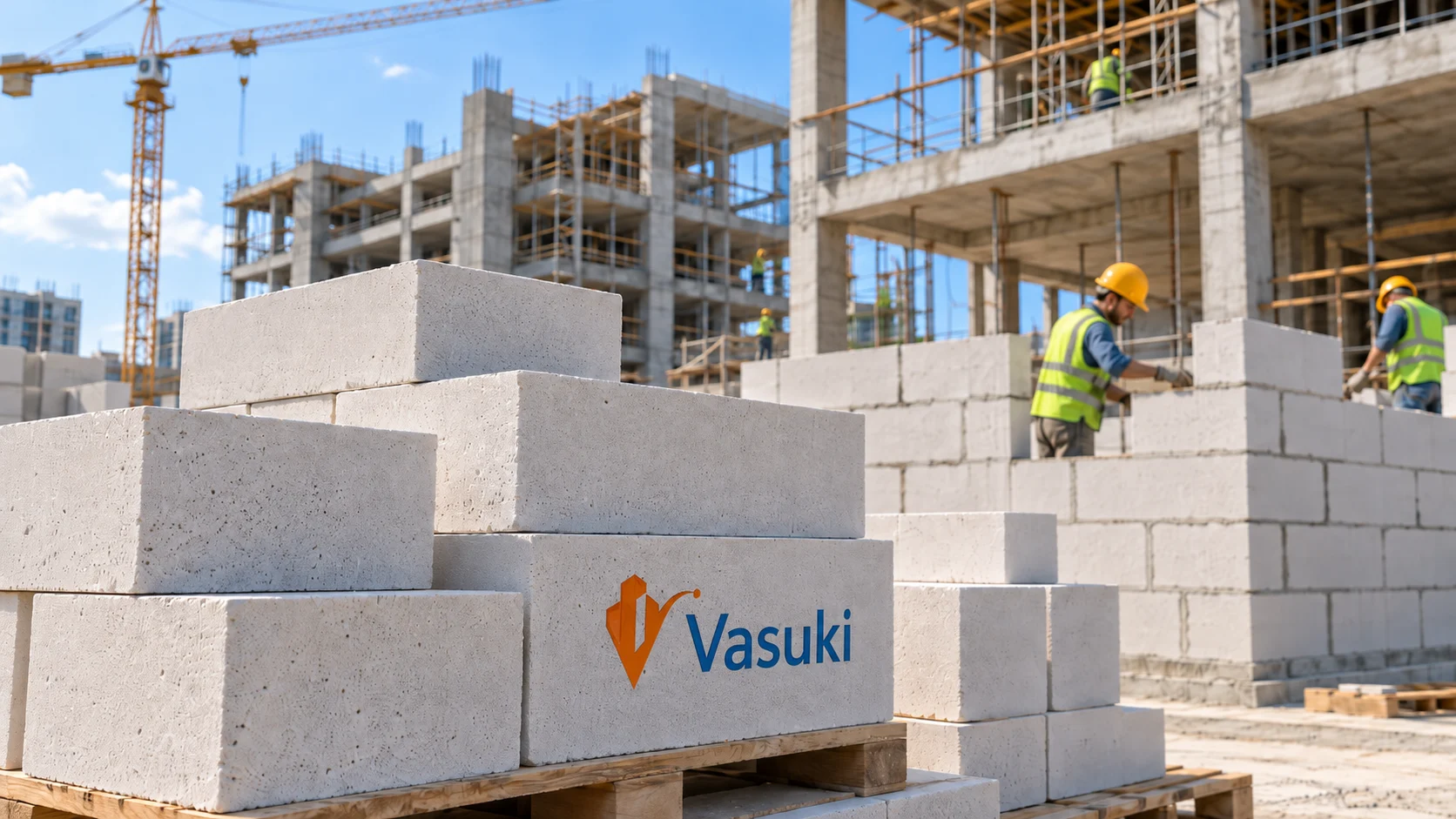
AAC blocks for commercial buildings are worth considering when a project needs lighter walls, faster masonry work, and good thermal insulation. For offices, retail spaces, warehouses, schools, and hospitals, the choice of wall material affects construction time, finishing costs, and the load placed on the building structure.
AAC, or autoclaved aerated concrete, is a lightweight precast building material made from cement, lime, water, sand or fly ash, and an aerating agent. The mixture develops a cellular structure and is cured in an autoclave. AAC blocks are used mainly for non-load-bearing infill walls and partitions in framed buildings.
However, choosing a wall material involves more than comparing the price of individual blocks. Builders also need to consider mortar, labour, plastering, transportation, structural design, and the requirements of the finished space.
This guide explains where AAC blocks work well, how to estimate their cost, what their strength means for commercial construction, and which limitations to consider before placing an order.
Can Commercial Buildings Use AAC Blocks?
01
Where AAC works: Infill and partition walls
AAC blocks are commonly considered for:
- Office buildings and IT parks, where internal layouts may need to change.
- Retail stores and shopping centres, where partitions divide different spaces.
- Warehouses and industrial buildings, where lightweight infill walls may be suitable.
- Schools and colleges, where thermal comfort and room separation matter.
- Hospitals and hotels, where room layouts and finishing requirements influence wall selection.
Their lower weight can reduce the dead load contributed by masonry. This may help reduce the load on the building’s structure.
02
Where limits apply: Load-bearing walls and special conditions
AAC blocks cannot replace concrete or other materials in every type of wall. Their use depends on the block’s strength, wall design, and building height.
In high-rise buildings, AAC blocks are mainly used for internal walls and external infill walls. The building’s frame supports the main loads.
Ask a structural engineer to check the wall design and how it connects to the frame. Use extra care in basements, wet areas, and places where walls may face heavy impact or support heavy equipment.
AAC Blocks Cost for Commercial Projects
AAC block prices depend on the block size, order quantity, transport and labour costs. AAC blocks may cost more per piece than red bricks. But you also need to consider the cost of building the full wall.
Compare the total wall cost, including materials, labour, and finishing, to find the more cost-effective option.
AAC blocks vs red bricks in Ahmedabad
| Comparison | AAC block wall | Red brick wall |
|---|---|---|
| Wall thickness | 100 mm (4 inches) | About 110 mm (4.3 inches) |
| Published material price | ₹40–56 per block | ₹7–12 per brick |
| Units needed per sq. ft. | About 0.77 blocks | About 4.5–5 bricks |
| Estimated masonry-unit cost per sq. ft. | ₹31–43 | ₹32–60 |
| Mortar or adhesive | AAC jointing adhesive | Cement-sand mortar |
| Laying labour | Get a local rate per sq. ft. | Get a local rate per sq. ft. |
| Plaster and finishing | Quote separately | Quote separately |
Takeaway: Compare the full cost of building a finished wall, including materials, labour, and plastering. The lowest block or brick price does not always mean the lowest overall cost.
01
How to calculate AAC block wall cost
Use this formula to estimate the cost of an AAC wall:
Total wall cost = Blocks + Jointing mortar + Labour + Plaster and finishing + Transportation + Wastage
For a complete project comparison, account for structural cost implications and any difference in construction time separately.
You can calculate the cost per square metre as follows:
Cost per sq m = Total wall construction cost ÷ Net wall area
For cost per square foot, divide the total wall cost by the net wall area measured in square feet.
02
An illustrative cost example
Suppose a commercial project requires a fixed area of internal partition walls. The procurement team receives separate quotations for AAC blocks and red bricks.
Instead of selecting the material with the lower unit price, the team should compare:
- The number and cost of units needed for the specified wall area.
- The quantity and cost of mortar.
- Masonry labour for each material.
- Delivery charges, breakage, and material wastage.
- Any structural or scheduling cost differences confirmed by the project team.
For example, a lower AAC block price does not guarantee a lower completed-wall cost if transportation is expensive or installation is inefficient. Equally, a higher block price does not necessarily make the finished wall more expensive if the system reduces mortar consumption and labour time.
This is an illustrative comparison method, not a live project quotation. Use current local supplier rates and actual site estimates before finalising your budget.
What affects AAC block prices?
Several factors influence the final AAC block price:
- Block size and thickness: These determine the number of units needed and the application for which they are suitable.
- Order volume: Bulk requirements may affect the supplier’s quotation and delivery arrangements.
- Transportation distance: Freight can make a noticeable difference to delivered cost, especially for bulky materials.
- Mortar and finishing: Jointing mortar, plaster, and protective finishes must be included in the estimate.
- Wastage and handling: Poor storage or rough handling can increase material losses.
- Quality requirements: Check the block’s strength and size. Ask for test reports to confirm its quality.
To get a quote, tell the supplier how many blocks you need, their size, where to deliver them, and how you plan to use them.
AAC Block Strength: What It Means for Commercial Walls
AAC block strength shows how much pressure a block can take before it breaks. For commercial buildings, the right block depends on the wall’s purpose and design.
AAC blocks are lightweight. But their strength can vary by product. Always choose blocks that meet your project’s needs.
01
What Is Compressive Strength?
Compressive strength tells you how much pressure a block can handle. This helps you decide if it is right for your wall.
An office partition may need different strength than an external wall. Walls in areas with heavy impact may need extra protection.
In India, IS 2185 (Part 3):1984 covers AAC blocks. Before buying, check the block’s grade and ask the supplier for test reports.
Do not check strength alone. Also check the block’s size, density, and shrinkage. These details help you choose the right AAC blocks for your project.
Planning to use AAC blocks? Explore Vasuki AAC Blocks and contact our team for product details and pricing.
02
How Are Density and Strength Related?
Density tells you how heavy a block is for its size. It also affects the block’s strength.
The link between density and strength varies by product. Check the supplier’s data sheet to compare blocks and choose the right one for your wall.
03
Are AAC blocks strong enough for high-rise buildings?
Yes, AAC blocks can be used for infill and partition walls in high-rise buildings when the design allows it.
The building’s frame carries the main structural loads. AAC blocks form the walls and add less weight than many other masonry materials.
The engineer must still check wall height, openings, frame connections, and movement. These details affect the safety and performance of the wall.
Wall Thickness, Fire and Sound Performance
Wall thickness affects the wall’s weight, strength, heat control, sound control, and fire safety.
The right thickness depends on the wall’s purpose, height, openings, and building needs.
The following are preliminary selection examples, not universal design specifications.
| Wall application | Example thickness | What to check |
|---|---|---|
| Light internal partition | 100 mm | Wall height, stability, and fixing requirements |
| Internal room or corridor wall | 150 mm | Acoustic needs, openings, and wall support |
| External wall | 200 mm | Weather protection, thermal performance, and structural connections |
| Fire-rated wall | As required by the design | Tested fire rating of the complete wall assembly |
Takeaway: Treat these thicknesses as starting points for design discussions. Confirm the final specification with the architect and structural or fire-safety consultant.
01
Thermal Performance and Fire Safety
AAC blocks do not catch fire easily. But a wall’s fire rating depends on its thickness, joints, and finish.
Commercial buildings must meet fire safety rules. Check the National Building Code of India and your project’s fire safety plan before choosing the wall system.
Do not assume a wall has a set fire rating without test reports to support it.
02
Sound Insulation
AAC walls can help reduce noise in rooms. But the result depends on the wall’s thickness, density, joints, doors, and openings.
Hotels, hospitals, and meeting rooms may need better sound control. Seal gaps around doors, pipes, and electrical fittings to help keep noise out.
Practical Uses of AAC Blocks by Commercial Building Type
| Building type | Where AAC blocks may fit | What to consider |
|---|---|---|
| Offices and IT parks | Internal partitions and external infill walls | Heavy cabinets, glass partitions, and service openings |
| Retail stores and malls | Internal divisions and infill walls | Fire compartments, signage, and impact protection |
| Warehouses and industrial buildings | Suitable boundary and infill walls | Forklift impact, moisture, and wall protection |
| Schools and colleges | Classroom partitions and corridor walls | Acoustic requirements and impact resistance |
| Hospitals | Room partitions and selected external walls | Hygiene, fire compliance, and equipment fixings |
| Hotels | Guest-room partitions and infill walls | Sound insulation around doors and service openings |
Takeaway: Choose AAC blocks based on the wall’s purpose and the building’s needs.
For example, offices may use AAC blocks for lightweight partitions that make it easier to plan room layouts. Warehouses may need extra protection in areas where forklifts or other equipment could hit the walls. Both buildings can use AAC blocks, but the type of wall and its needs will differ.
AAC Blocks vs Red Bricks vs Concrete Blocks
| Factor | AAC blocks | Red clay bricks | Concrete blocks |
|---|---|---|---|
| Weight | Lightweight | Generally heavier | Depends on whether hollow, solid, or lightweight |
| Thermal insulation | Generally good | Depends on brick and wall construction | Depends on block type and wall construction |
| Construction speed | Larger units can speed up laying | More individual units to lay | Depends on unit size and system |
| Compressive strength | Product-specific; commonly used for non-load-bearing infill | Depends on brick grade and masonry design | Depends on block type and grade |
| Water absorption | Requires suitable moisture protection | Depends on brick properties | Depends on block properties |
| Typical use | Framed-building infill and partitions | General masonry applications | Infill, partitions, and other applications according to block type and design |
Takeaway: AAC is worth evaluating when lower wall weight, insulation, and laying speed matter. Concrete blocks or red bricks may be more appropriate in other conditions.
Avoid comparing materials using broad labels such as strong, weak, or waterproof. Ask suppliers for the relevant test data and compare equivalent wall assemblies.
Where AAC Blocks Are Not the Right Choice
01
Below the plinth and in persistently wet areas
AAC requires appropriate moisture protection. Do not assume it is suitable for buried masonry, basements, or constantly wet locations without a designed system that addresses water exposure.
02
Walls carrying heavy point loads
03
Exposed walls without suitable protection
04
Areas exposed to repeated impact
05
Projects without suitable installation practices
How to Choose an AAC Block Supplier
01
Check product quality and specifications
Ask for details about the blocks’ compressive strength, density, size, and dimensional accuracy. Request relevant test reports and check that the specifications match your wall design. Consistent block sizes can also help masons lay walls more evenly and reduce problems during finishing.
02
Confirm supply capacity
For commercial and large-scale projects, check whether the supplier can meet your order quantity and planned delivery dates. Delays in receiving AAC blocks can slow down masonry work and affect other teams on site. If you need supplies in stages, discuss the quantities and delivery schedule before confirming the order.
03
Understand the complete cost
Do not compare suppliers on block price alone. Ask for a quotation that clearly lists the block specifications, quantity, transportation charges, and any other applicable costs. Also consider the cost of jointing adhesive, labour, and finishing when estimating the total wall cost.
04
Check delivery and material handling
Confirm how the blocks will be transported, unloaded, and stacked at the site. On delivery, inspect the blocks for visible damage and check that the size and quantity match your order. Proper handling helps reduce breakage and avoid material waste.
05
Choose a supplier who understands your project
The right supplier should be able to explain the available product specifications, help you identify the information needed for ordering, and clarify delivery requirements. Share your wall dimensions, estimated quantity, project location, and delivery timeline to help the supplier prepare a suitable quotation.
When these details are clear from the start, it becomes easier to plan material purchases, manage site work, and compare supplier offers fairly.
Looking for AAC blocks for your next project in Gujarat?
Vasuki AAC Blocks offers a product option for builders, contractors and developers looking to source construction materials. Share your project requirements with the team to discuss block specifications, order quantities, and delivery needs.
Choosing AAC Blocks for Commercial Buildings
AAC blocks for commercial buildings are worth considering when lightweight infill walls, construction speed, and thermal insulation are priorities. Their suitability depends on the wall’s purpose, the building’s structural design, the required performance, and the quality of installation.
Before making a decision, remember three things:
- Compare the cost of the completed wall, including mortar, labour, finishes, and transportation.
- Select blocks using verified strength, density, and dimensional data, not assumptions about the material.
- Confirm wall thickness, moisture protection, fire performance, connections, and installation details with the project team.
For your next commercial project, request a quotation for Vasuki AAC Blocks based on your required dimensions, quantity and delivery location. A project-specific quotation will help you assess the material cost and plan procurement more accurately.
FAQs
Can AAC blocks be used in commercial buildings?
Are AAC blocks strong enough for high-rise buildings?
Are AAC blocks cheaper than red bricks?
What thickness of AAC block is used for commercial walls?
Are AAC blocks fire resistant?
Looking for Cement Supply or Dealership?
Partner with us for consistent quality, competitive pricing, and dependable delivery.
Looking for Cement Supply or Dealership?
Partner with us for consistent quality, competitive pricing, and dependable delivery.