 88222 82888

TMT Steel Bar Grades Explained: Fe 500, Fe 500D, Fe 550, and Fe 550D
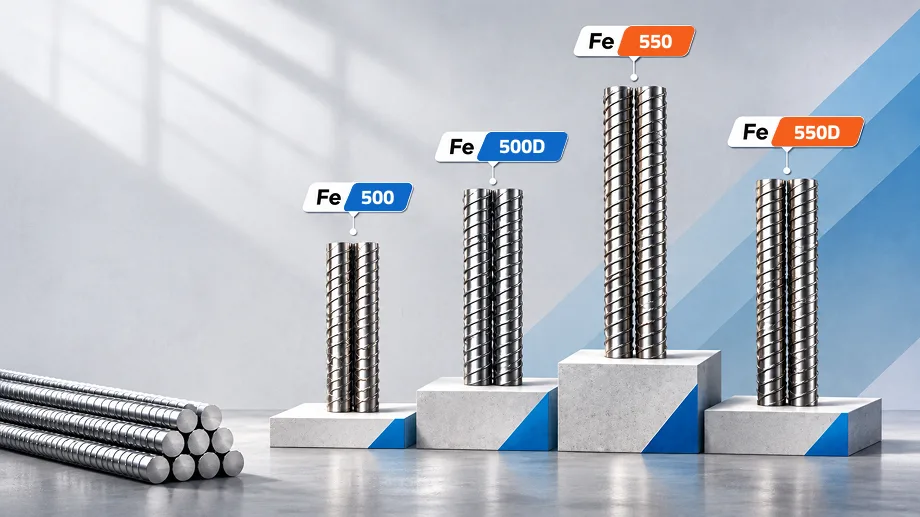
Steel is one of the main materials used in construction. It gives concrete the strength it needs to support buildings, bridges, and other structures. This is why RCC (reinforced cement concrete) construction uses TMT bars (Thermo-Mechanically Treated).
However, not all TMT bars have the same properties. They are available in different grades, such as Fe 500, Fe 500D, Fe 550 and Fe 550D. Each grade has different strength and ductility requirements.
Why does this matter?
Imagine you are building a house. The steel used in its foundation, columns, beams, and slabs must be able to handle the loads placed on the structure. If the steel does not meet the required specifications, it can affect the building’s safety and performance.
This is why choosing the right TMT steel bar grade is important. The grade tells you how strong the steel needs to be and how much it should stretch before breaking.
In this guide, we will explain what these grades mean, how they differ and what you should check before buying TMT bars. Whether you are a homeowner, contractor, or builder, this will help you understand the specifications and make informed purchasing decisions
What Do Fe 500, Fe 500D, Fe 550 and Fe 550D Mean?
01
What Does TMT Mean?
TMT stands for Thermo-Mechanically Treated. It refers to a process used to produce steel bars with a strong outer surface and a more ductile inner core.
During manufacturing, hot steel bars pass through a rapid water-cooling process. Their outer layer hardens, while the heat remaining inside helps temper the bar. This gives TMT bars a combination of strength and ductility.
In simple words, the outer layer helps the bar resist stress, while the inner core allows it to bend and stretch to a certain extent without breaking.
02
Understanding Fe, the Grade Number and D
Let’s break down a grade name such as Fe 500D.
- Fe: This is the chemical symbol for iron, the main element in steel.
- 500: This number represents the minimum yield strength of the bar, measured in megapascals (MPa).
- D: This indicates enhanced ductility, which means the bar must meet higher elongation and tensile-strength requirements than the corresponding non-D grade.
For example, Fe 500 and Fe 500D both have a minimum yield strength of 500 MPa. However, Fe 500D has higher ductility requirements.
Similarly, Fe 550 and Fe 550D both have a minimum yield strength of 550 MPa.
03
Yield Strength vs Tensile Strength: What Is the Difference?
These two terms are often mentioned in TMT bar specifications. Understanding them is easier than it sounds.
Yield strength is the stress at which steel starts to deform permanently. Before reaching this point, a bar can return to its original shape when the load is removed, as long as it remains within its elastic limit.
Tensile strength is the maximum stress the steel can withstand during a pulling test before it starts losing its ability to carry the load and eventually breaks.
Think of pulling a steel wire. It first stretches slightly. As you keep pulling, it starts to deform permanently. If you continue, it eventually reaches its maximum strength and breaks.
This is why both properties matter. Yield strength tells engineers when permanent deformation begins, while tensile strength tells them how much stress the material can handle at its maximum.
TMT Steel Bar Grades Compared: Strength, Elongation and Other Properties
Now that we understand the basic terms, let’s compare the four TMT steel bar grades.
The following TMT bar grade chart shows the minimum mechanical properties specified under IS 1786:2008.
| Property | Fe 500 | Fe 500D | Fe 550 | Fe 550D |
|---|---|---|---|---|
| Minimum yield strength | 500 MPa | 500 MPa | 550 MPa | 550 MPa |
| Minimum tensile strength | 545 MPa | 565 MPa | 585 MPa | 600 MPa |
| Minimum tensile-to-yield ratio | 1.08 | 1.10 | 1.06 | 1.08 |
| Minimum elongation | 12% | 16% | 10% | 14.5% |
Note: These are minimum mechanical requirements, not guaranteed test results for every batch. Check the applicable edition and amendments of IS 1786 when specifying or purchasing steel.
What Do These Numbers Tell Us?
01
Yield strength
Fe 550 and Fe 550D have a minimum yield strength of 550 MPa, compared with 500 MPa for Fe 500 and Fe 500D.
This means Fe 550 grades can withstand higher stress before permanent deformation begins.
02
Tensile strength and tensile-to-yield ratio
Tensile strength tells us the maximum stress a bar can withstand during a tensile test. The tensile-to-yield ratio compares the actual tensile strength with the actual yield strength.
A higher ratio means there is a larger difference between the two strengths. This helps indicate how the steel behaves after it starts yielding.
03
Elongation
Elongation tells us how much a steel sample stretches before breaking during a tensile test.
For example, Fe 500D has a minimum elongation requirement of 16%, while Fe 500 has 12%.
This means Fe 500D must meet a higher stretching requirement before breaking.
The main takeaway is simple: higher grade numbers indicate higher minimum yield strength, while the D designation indicates enhanced ductility requirements.
Why Does D Matter? Understanding Ductility and Earthquake Safety
01
What Is Ductility?
Ductility is the ability of a material to bend or stretch without breaking immediately.
Think of a metal wire. If you bend it slightly, it changes shape. If you keep bending it, it may eventually break. A more ductile material can undergo more deformation before breaking.
In construction, this property matters because buildings experience different types of forces. These include the weight of the structure, wind, movement of the ground, and earthquakes.
02
Why Does Ductility Matter During Earthquakes?
During an earthquake, the ground moves and causes buildings to shake. This puts stress on beams, columns, and other structural members.
If the reinforcement steel is too brittle, it may break suddenly when subjected to excessive deformation. More ductile reinforcement can stretch and deform before breaking, helping a properly designed structure absorb and redistribute energy.
This is one reason why ductility is important in earthquake-resistant construction.
However, using Fe 500D or Fe 550D alone does not make a building earthquake-resistant. The entire structure must be designed and built to handle seismic forces. This includes the correct reinforcement layout, beam-column connections, concrete quality, and construction practices.
03
What Do Indian Standards Say?
Two Indian Standards are especially relevant here:
- IS 1786: Specifies the requirements for high-strength deformed steel bars and wires used in concrete reinforcement. It covers grades, mechanical properties, chemical composition, and testing.
- IS 13920: Covers the ductile design and detailing of reinforced concrete structures subjected to seismic forces.
IS 13920 includes requirements for reinforcement used in ductile structural systems. It is important to check its exact provisions and the applicable amendments rather than assuming that every D-grade bar automatically meets every seismic design requirement.
04
Why Does This Matter in Gujarat?
Gujarat has areas with a history of strong earthquakes. The 2001 Bhuj earthquake is a reminder of the damage that seismic forces can cause to buildings and infrastructure.
For this reason, earthquake-resistant design is an important consideration in construction across the state. However, seismic requirements vary by location and building design.
If you are planning construction in Gujarat or another earthquake-prone area, consult a structural engineer about the applicable seismic zone, building code requirements, and reinforcement specifications.
Fe 500 vs Fe 500D: What Is the Difference?
| Property | Fe 500 | Fe 500D |
|---|---|---|
| Minimum yield strength | 500 MPa | 500 MPa |
| Minimum tensile strength | 545 MPa | 565 MPa |
| Minimum elongation | 12% | 16% |
| Minimum tensile-to-yield ratio | 1.08 | 1.10 |
The main difference is ductility.
Fe 500D must stretch more before breaking and meet a higher tensile-to-yield ratio requirement than Fe 500.
01
Which One Should You Choose?
Fe 500 may be suitable when the structural design specifies this grade. Fe 500D may be specified when the design requires higher ductility.
For buyers, one important point is worth remembering: if your structural drawings specify Fe 500D, do not accept Fe 500 as a replacement simply because both have a yield strength of 500 MPa.
Always check the grade mentioned in the purchase order and structural drawings. If a substitution is proposed, get approval from the structural engineer.
Fe 550 vs Fe 550D: What Sets Them Apart?
| Property | Fe 550 | Fe 550D |
|---|---|---|
| Minimum yield strength | 550 MPa | 550 MPa |
| Minimum tensile strength | 585 MPa | 600 MPa |
| Minimum elongation | 10% | 14.5% |
| Minimum tensile-to-yield ratio | 1.06 | 1.08 |
Fe 550 offers higher minimum yield strength than Fe 500. Fe 550D combines this higher strength with enhanced ductility requirements.
This makes Fe 550D an option for projects where the structural design calls for both higher strength and ductility.
For contractors and buyers, the important thing is to match the grade with the project specifications. Do not replace Fe 550 with Fe 550D, or the other way around, without checking the engineer’s approval.
Does a Higher TMT Bar Grade Save Steel and Money?
A common belief among buyers is that a higher TMT bar grade always means a stronger building and lower material costs. But this is not always true.
A higher grade has greater minimum yield strength. In some structural designs, this may allow engineers to use a smaller quantity of steel to meet the required strength.
For example, an engineer may be able to reduce the reinforcement area in certain members when using Fe 550 instead of Fe 500. However, this depends on the complete design and the limits set by the applicable codes.
01
Where Can Higher Grades Help?
Higher-strength grades may be useful in structural members where strength is the main design factor. These may include certain columns, beams, long-span structures, and industrial buildings.
However, the final design must also consider:
- Deflection, or how much a beam or slab bends under a load.
- Crack width and control.
- Reinforcement spacing and detailing.
- Concrete strength and the behaviour of the complete structure.
Common Misconceptions About Higher Grades
01
Misconception 1: A higher grade always makes a stronger building.
02
Misconception 2: D means higher yield strength.
03
Misconception 3: You can replace Fe 500 with Fe 550 at the site.
04
Misconception 4: Higher grades always reduce construction costs.
Not always. The steel price, quantity required, design limitations, and other construction costs all affect the final budget.
The right approach is to let the engineer select the grade and compare the total material requirement, not just the price per kilogram.
Which Is the Best TMT Bar Grade for Construction?
01
Residential Buildings
Fe 500 and Fe 500D are commonly considered for residential RCC construction.
Fe 500 provides the required strength when specified in the structural design. Fe 500D offers enhanced ductility and may be selected when the design requires it.
For a homeowner, the most important step is to follow the structural drawings rather than selecting a grade based on price or a supplier’s recommendation alone.
02
Multi-Storey and Commercial Buildings
Multi-storey buildings and commercial structures may experience different loads depending on their height, layout, and use.
Fe 500D, Fe 550, and Fe 550D may be considered by engineers depending on the design requirements.
A higher-strength grade may help in certain structural members, but the engineer must also check ductility, deflection, crack control, and seismic detailing.
03
Industrial Structures
Factories, warehouses, and industrial buildings may need to support heavy machinery, equipment, and stored materials.
In such projects, higher-strength grades such as Fe 550 or Fe 550D may be specified where the design requires them.
However, the steel grade is only one part of the design. The foundation, columns, beams, connections, and concrete must also be designed for the expected loads.
04
Earthquake-Prone Areas
In earthquake-prone areas, ductility is an important factor in reinforcement selection.
Fe 500D and Fe 550D have enhanced ductility requirements compared with their non-D counterparts. They may be considered where the structural design calls for these properties.
Still, a D-grade bar cannot replace proper earthquake-resistant design and detailing. The structural engineer must follow the applicable seismic standards.
05
What should buyers remember?
Do not choose a TMT bar only because it has the highest grade number. Ask for the grade specified in the structural drawings, verify the material, and follow the engineer’s recommendation.
What Is IS 1786 and Why Does It Matter?
When buying TMT bars in India, you will often come across the term IS 1786.
IS 1786 is an Indian Standard published by the Bureau of Indian Standards (BIS). Its full title is High Strength Deformed Steel Bars and Wires for Concrete Reinforcement: Specification.
In simple terms, it sets the requirements that reinforcement steel must meet before it can be classified under a particular grade.
What Does IS 1786 Cover?
01
Mechanical properties
02
Chemical composition
03
Bend and rebend tests
04
Dimensions and weight
Why Should Buyers Check IS 1786 Compliance?
A TMT bar may look strong from the outside, but its appearance cannot confirm its actual mechanical properties.
Checking the applicable BIS certification, grade markings, and test documents helps buyers verify whether the supplied steel meets the required specifications.
When purchasing TMT bars, ask the supplier for the relevant test certificate and check that the grade and batch details match the material delivered to your site.
How to Check Whether TMT Bars Are Genuine
Choosing the correct grade is only the first step. You should also check whether the bars delivered to your site match the grade and specifications you ordered.
Here are five practical checks for buyers and contractors.
01
Check the BIS Certification
Look for the BIS Standard Mark, commonly called the ISI mark, and the manufacturer’s licence number.
You can use the BIS Care app’s Verify Licence Details feature to check the licence information. Confirm that the licence is valid and covers the relevant product and grade.
Do not rely on a printed logo alone. Verify the licence details.
02
Check the Bar Markings
TMT bars usually have rolled markings that help identify the manufacturer and product.
Check the markings against the brand and grade mentioned in your purchase order. If the markings do not match, ask the supplier for an explanation before accepting the material.
03
Ask for the Mill Test Certificate
A Mill Test Certificate (MTC) provides test information about a particular batch of steel.
It generally includes details such as:
- Grade and nominal diameter.
- Heat or batch number.
- Chemical composition.
- Yield strength.
- Tensile strength.
- Elongation.
Match the heat number on the certificate with the bundle tag or other supplied identification. This helps confirm that the certificate belongs to the material delivered to your site.
04
Check the Weight and Diameter
TMT bars are available in different nominal diameters, such as 8 mm, 10 mm, 12 mm, 16 mm and 20 mm.
The required diameter should match your structural drawings.
You can also estimate the nominal weight per metre using this formula:
Weight per metre = D² ÷ 162
Here, D is the nominal diameter of the bar in millimetres.
For example:
| Bar diameter | Approximate nominal weight per metre |
|---|---|
| 8 mm | 0.395 kg |
| 10 mm | 0.617 kg |
| 12 mm | 0.889 kg |
| 16 mm | 1.58 kg |
| 20 mm | 2.47 kg |
These are approximate nominal weights. Actual measured weights must be checked against the tolerances allowed under the applicable standard.
For a site-level check, weigh a measured sample of bars and compare the result with the expected nominal weight. If the difference appears large, ask the supplier or engineer to investigate.
05
Inspect the Surface Condition
Before accepting the delivery, inspect the bars for visible defects such as:
- Deep rust or heavy rust scale.
- Cracks or damaged ribs.
- Dents and other physical damage.
- Uneven or visibly damaged surfaces.
Light surface rust may occur during storage and does not automatically mean the steel is unsuitable. However, heavy corrosion, pitting, or damage should be checked by the site engineer.
These checks help buyers reduce the risk of accepting material that does not match the purchase order.
Common Mistakes to Avoid When Buying TMT Bars
Even experienced buyers can make mistakes when purchasing reinforcement steel. Here are some common ones to avoid.
1. Choosing only by price: A lower price does not always mean a better deal. Check the grade, certification, and test results before comparing prices.
2. Ignoring the grade marking: Do not accept a different grade simply because the supplier says it offers similar strength.
3. Treating D as a marketing term: D indicates specific ductility requirements under the standard. It is not just an extra letter in the product name.
4. Changing grades without approval: Never substitute one grade for another at the construction site without approval from the structural engineer.
5. Ignoring material documents: Always ask for the relevant test certificate and keep it with the project records.
6. Storing bars incorrectly: Avoid leaving reinforcement steel directly on wet soil or in conditions that can lead to heavy corrosion. Store it properly and follow site instructions.
Choose the Right TMT Bar Grade for Your Project
Fe 500, Fe 500D, Fe 550, and Fe 550D may look similar, but their strength and ductility requirements are different.
Fe 500 and Fe 500D have a minimum yield strength of 500 MPa, while Fe 550 and Fe 550D have a minimum yield strength of 550 MPa. The D grades have higher minimum elongation and tensile-strength requirements than their non-D counterparts.
Understanding these differences helps you make better purchasing decisions. However, the right grade should always be selected according to the structural design and applicable standards.
At Vasuki, TMT bars are available in Fe 500, Fe 500D and Fe 550D grades. Each grade serves different structural requirements, giving buyers options based on their project specifications.
Planning your next construction project? Explore Vasuki TMT or connect with the team to discuss your steel requirements.
FAQs
What are the different grades of TMT steel bars?
What is the difference between Fe 500 and Fe 500D?
Is Fe 550 stronger than Fe 500?
Which is better, Fe 500D or Fe 550D?
What does D mean in TMT steel bars?
Looking for Cement Supply or Dealership?
Partner with us for consistent quality, competitive pricing, and dependable delivery.
Looking for Cement Supply or Dealership?
Partner with us for consistent quality, competitive pricing, and dependable delivery.