 88222 82888

Best Cement for Roof Construction: What Should You Buy?
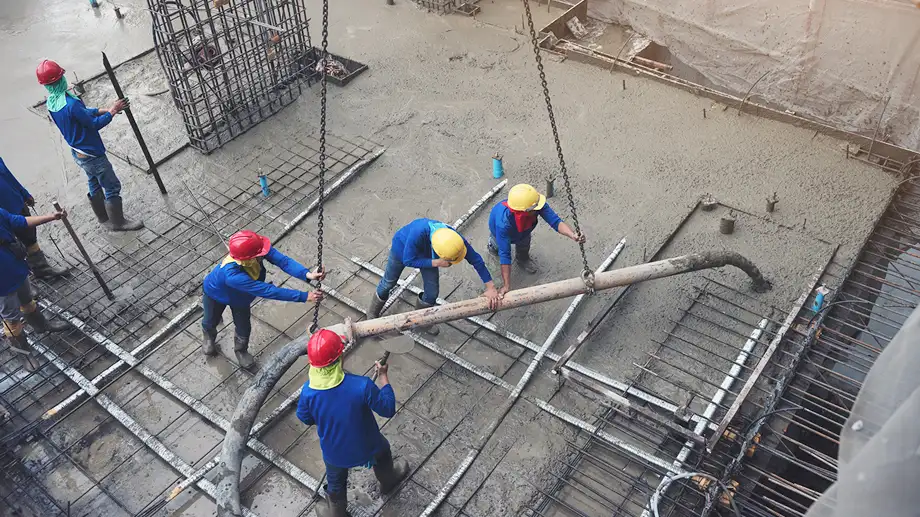
Choosing cement for a roof slab can feel surprisingly confusing. One contractor may recommend OPC 53 because it gains strength quickly. Another may recommend PPC because it is considered more durable and less prone to heat-related cracking. Then there is PSC, and in some projects, GGBS enters the discussion.
So, what is actually the best cement for roof construction?
The right choice depends on your concrete specification, construction schedule, exposure conditions, and the priorities of your project.
For most standard residential RCC roof slabs, PPC is a sensible default when the mix is properly designed, placed and cured. OPC can be the better choice when early strength is important. PSC or a concrete mix incorporating GGBS becomes particularly interesting in coastal or chemically aggressive environments.
The important point is this cement type and concrete grade are not the same thing. If your structural drawing specifies M20 or M25 concrete, you need a concrete mix that achieves that grade. You cannot replace an M25 specification simply by buying OPC 53 instead of PPC.
What a Roof Slab Actually Needs From Its Cement
Think of your roof slab as a long-term system rather than just a layer of concrete. The cement is one part of that system.
A good roof slab needs five things from its cement and concrete mix:
- Adequate compressive strength to safely carry the loads specified by the structural design.
- Controlled heat generation during hydration, particularly during large or hot-weather pours.
- Durability against moisture, carbonation, chloride exposure, and other environmental effects appropriate to the site.
- Low permeability, so water has less opportunity to reach the reinforcement.
- Reliable long-term strength development, provided the concrete is correctly proportioned, placed, and cured.
This is why simply asking a dealer for the “strongest cement” is not the best way to buy cement for a roof.
A practical example: suppose your engineer has designed an M25 roof slab. The important question is not “Should I buy 43 or 53 grade cement?” in isolation. The question is whether the proposed concrete mix, using a cement conforming to the relevant standard, will achieve the specified M25 grade and durability requirements.
IS 456:2000 is the relevant Indian Standard for plain and reinforced concrete practice, including provisions dealing with durability, concrete mix proportioning and related construction requirements.
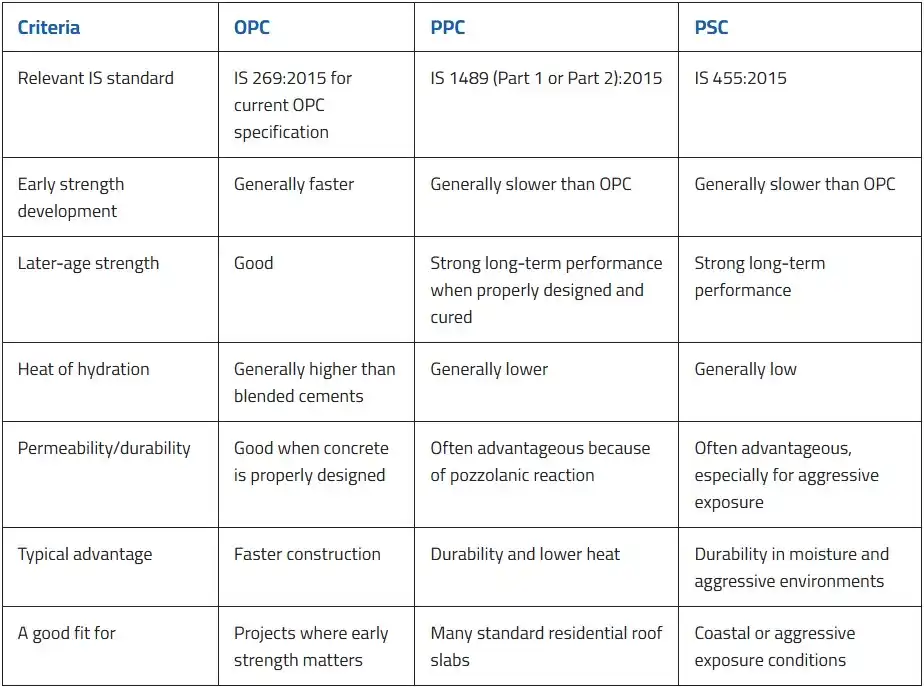
OPC vs PPC vs PSC: The Direct Comparison for Roof Slabs
| Criteria | OPC | PPC | PSC |
|---|---|---|---|
| Relevant IS standard | IS 269:2015 for current OPC specification | IS 1489 (Part 1 or Part 2):2015 | IS 455:2015 |
| Early strength development | Generally faster | Generally slower than OPC | Generally slower than OPC |
| Later-age strength | Good | Strong long-term performance when properly designed and cured | Strong long-term performance |
| Heat of hydration | Generally higher than blended cements | Generally lower | Generally low |
| Permeability/durability | Good when concrete is properly designed | Often advantageous because of pozzolanic reaction | Often advantageous, especially for aggressive exposure |
| Typical advantage | Faster construction | Durability and lower heat | Durability in moisture and aggressive environments |
| A good fit for | Projects where early strength matters | Many standard residential roof slabs | Coastal or aggressive exposure conditions |
01
A note about the OPC codes
You may still see cement articles, old specifications or people on site referring to IS 8112 for OPC 43 and IS 12269 for OPC 53, alongside IS 269 for OPC 33.
There is an important update here. BIS revised the OPC standard in 2015, bringing the requirements for OPC 33, 43 and 53 grades into IS 269:2015. The earlier IS 269, IS 8112 and IS 12269 versions were subsequently withdrawn after the transition period.
So if someone says “OPC 53 as per IS 12269,” they may be using the familiar older reference. For a current specification, check the cement bag and applicable BIS certification against the current standard.
For PPC, BIS specifies IS 1489 (Part 1) for fly-ash-based PPC and IS 1489 (Part 2) for calcined-clay-based PPC.
PSC is covered by IS 455, which specifies Portland Slag Cement. BIS describes PSC as cement incorporating granulated slag and specifies requirements for its manufacture and performance.
So, Is PPC or OPC Better for Roof Construction?
This is where the real debate begins.
If somebody tells you “OPC is always better for a roof slab,” that is too simplistic.
If somebody says “PPC is always better because it never cracks,” that is also wrong.
Cracking in an RCC roof can result from many factors, including shrinkage, thermal movement, poor curing, excessive water, reinforcement detailing, settlement, restraint and construction practices. Changing cement type alone does not guarantee a crack-free slab.
01
Choose PPC when durability and controlled heat are your priorities
For a typical residential roof slab, PPC is often a practical choice when you are not working under a tight early-strength schedule.
Its blended composition can contribute to lower heat development and improved durability characteristics as the concrete matures. But PPC is not a shortcut around good workmanship. It still needs appropriate mix design, placing and curing.
Imagine a family home where the roof slab is cast once, the formwork does not need to be stripped immediately, and the objective is a durable structure for decades. There is usually little benefit in choosing a cement solely because it offers faster early strength.
That is where PPC can make sense.
BIS confirms PPC as a standardized cement type under IS 1489, with both fly-ash-based and calcined-clay-based varieties covered by the standard.
02
Choose OPC when early strength and construction speed matter
OPC has an advantage when you genuinely need faster early strength development.
For example, imagine a contractor managing a project where the construction cycle is very tight and formwork needs to be removed according to an engineer-approved schedule. Faster strength development may be valuable.
That does not mean “OPC 53 automatically makes the slab stronger.”
The concrete grade still comes from the concrete mix and its achieved strength. OPC 53 is a cement grade, while M25 is a concrete grade. They describe different things.
For a normal home, do not choose OPC 53 simply because “53 is stronger than 43.” First check what the structural engineer has specified and what mix design is being used.
Where Do PSC and GGBS Fit In?
This is particularly important if you are building near the coast.
A coastal roof is exposed to a more demanding environment than an inland roof. Moisture and airborne chlorides can create durability concerns, particularly if concrete is permeable or reinforcement is inadequately protected.
That is where blended cement systems can become especially useful.
PSC, covered by IS 455, contains granulated slag and is widely used where durability is an important consideration. BIS documentation notes that PSC uses granulated slag as a major constituent and recognizes its application in construction.
Then there is GGBS, which is often misunderstood.
GGBS is not simply another brand of cement. It is a supplementary cementitious material. BIS covers Ground Granulated Blast Furnace Slag for use in cement, mortar and concrete under IS 16714:2018.
In a suitably designed concrete mix, GGBS can be used with Portland cement to improve durability characteristics and reduce permeability. This can make it worth discussing with the structural engineer for coastal construction or other aggressive exposure conditions.
For example, if you are building a house close to the Gujarat coast, choosing a concrete system designed for the actual exposure can be more important than simply choosing the cement with the highest early strength.
The Gujarat Climate Question: Does Your Location Change the Choice?
Yes, the environment matters.
Gujarat gives you a useful example because construction conditions can vary considerably. Hot, dry periods can increase evaporation from fresh concrete, while the monsoon introduces high humidity and repeated wetting.
That does not mean there is a special “Gujarat cement” you should buy.
Instead, ask:
- Is the site inland or close to the coast?
- Is the concrete being poured during very hot weather?
- Will the roof remain exposed to rain?
- Is there aggressive soil or groundwater?
- Is the project subject to chloride or sulphate exposure?
- Does the engineer’s specification call for a particular cement or supplementary cementitious material?
For a normal inland residential roof, PPC can be a sensible default when permitted by the project specification.
For a coastal or otherwise aggressive environment, discuss PSC or a GGBS-containing concrete mix with the engineer rather than making the decision at the dealer counter.
Cement Type and Concrete Grade Are Two Different Things
This is one of the most common sources of confusion for homeowners.
Suppose your structural drawing says:
Roof slab: M25 concrete
That does not mean you need to buy “M25 cement.”
M25 is a concrete grade. It refers to the specified characteristic compressive strength of concrete at 28 days.
The cement may be OPC, PPC, PSC or another permitted cementitious system, provided the resulting concrete complies with the structural and durability requirements.
So the correct sequence is:
Structural drawing → concrete grade → approved mix → suitable cementitious materials → controlled water and aggregates → proper placing, compaction and curing
Do not reverse that process by buying cement first and then asking the contractor to make the required concrete grade.
Getting the Roof Slab Right Beyond Just the Cement
01
Do not add extra water casually
This is one of the biggest mistakes made on construction sites.
A worker may say, “The concrete is too stiff, add a little water.”
That may make the concrete easier to place, but uncontrolled additional water can increase the water-cementitious-material ratio and reduce strength and durability.
The correct water content should come from the approved concrete mix and site requirements. IS 456 includes provisions covering durability and concrete mix proportioning.
If workability is a problem, ask the engineer or batching plant about the appropriate solution rather than simply adding buckets of water.
02
Check reinforcement cover
Cover protects reinforcement from the surrounding environment.
The required nominal cover is not one universal number for every roof. It depends on exposure, reinforcement and the design requirements. IS 456 contains the relevant provisions, so the structural drawing should take precedence over a generic “25 mm” or “40 mm” rule.
This matters especially in coastal or aggressive environments.
03
Cure properly
Concrete needs moisture and time to develop its intended properties.
Do not assume that because the slab looks hard after a day or two, curing is finished.
PPC and other blended systems can benefit from appropriate and adequate curing because their strength development continues over time. The exact curing regime should follow the project specification and applicable code requirements.
04
Plan the pour around the weather
In very hot weather, fresh concrete can lose water rapidly.
If you are casting a roof slab in peak summer, your contractor should plan the pour, concrete temperature, placing sequence, finishing and curing accordingly.
An early-morning or otherwise suitable pour can make site control easier, but the exact timing should depend on actual weather and project logistics.
05
Do not ignore roof drainage
A “flat” roof should not be confused with a roof that allows water to stand indefinitely.
The structural slab, screed and waterproofing system should be designed and executed so that water drains as intended.
A good cement cannot compensate for poor waterproofing or persistent ponding.
A Simple Decision Framework: Which Cement Should You Buy?
01
Choose PPC if your priority is:
- Long-term durability
- Lower heat development
- A normal residential construction schedule
- A standard inland residential roof slab, subject to the engineer’s specification
02
Choose OPC if your priority is:
- Faster early strength development
- Faster construction cycles
- Earlier formwork removal where specifically permitted by the engineer
- A project where early-age strength genuinely matters
03
Discuss PSC if your priority is:
- Better durability for demanding moisture exposure
- Coastal construction
- Potential chloride or other aggressive exposure concerns
- A concrete system designed around durability rather than simply early strength
04
Discuss GGBS if:
- The project has significant durability requirements
- The site is coastal or otherwise aggressive
- Your concrete supplier and structural engineer can design and approve an appropriate GGBS-containing mix
The key word in all four cases is “if.”
There is no responsible way to choose roof cement without considering the structural specification and exposure conditions.
Quick Buying Checklist for Your Roof Slab
Before the truck arrives, check these five things:
- Concrete grade: Confirm whether the drawing specifies M20, M25 or another grade.
- Cement type: Confirm OPC, PPC, PSC or another approved cementitious system with the engineer.
- BIS compliance: Check the relevant IS standard and certification marking on the bag.
- Manufacturing/storage condition: Avoid cement that is visibly damp, badly stored or heavily lumpy.
- Mix and water control: Make sure the approved mix is followed and extra water is not added casually.
Also remember that cement quality is only one part of slab quality. Aggregates, water, batching, reinforcement, cover, compaction, curing, and workmanship all contribute to the final result.
Final Answer: What Is the Best Cement for a Roof?
For most standard residential roof slabs in India, PPC is a strong default choice when it is permitted by the structural specification and the concrete is properly designed, placed and cured. Its lower heat development and long-term durability characteristics make it attractive for a one-time residential roof pour where immediate strength is not the main priority.
OPC is not inferior. It becomes particularly useful when early strength and construction speed are important.
PSC or a GGBS-containing concrete mix deserves serious consideration for coastal or chemically aggressive environments, where durability can be more important than rapid early strength.
And before you buy anything, remember the most important distinction:
Cement type is not concrete grade.
If your structural drawing says M25, the goal is to produce compliant M25 concrete using an appropriate cementitious system and approved mix. Do not let a dealer’s “53 is stronger” argument replace the engineer’s specification.
When in doubt, take a photo of the structural drawing to the engineer or contractor and ask one simple question: “Which cement type and concrete mix are specified for this slab, and why?”
That answer is worth far more than choosing a bag based only on the number printed on it.
FAQs
What is the best cement for a roof slab?
Is OPC or PPC better for roof construction?
What grade of cement is used for a roof slab?
Does PPC cement crack less than OPC?
Can PSC cement be used for roof slabs?
Looking for Cement Supply or Dealership?
Partner with us for consistent quality, competitive pricing, and dependable delivery.
Looking for Cement Supply or Dealership?
Partner with us for consistent quality, competitive pricing, and dependable delivery.