 88222 82888

Building Construction Materials: The Complete Guide for 2026
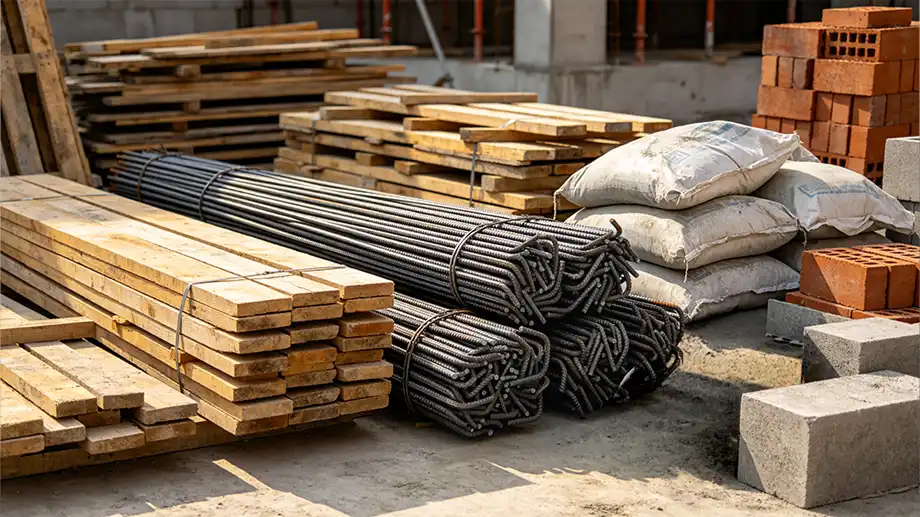
Every construction mistake has a material decision at its root. The wrong cement grade, an undersized rebar, or a walling material that absorbs monsoon moisture can cost more to fix than getting the building construction materials right in the first place.
Building construction materials are the physical materials used to construct the structural framework, walls, floors, and finishes of a building. In modern Indian construction, the primary building construction materials are cement (OPC, PPC, PSC, GGBS grades), TMT steel reinforcement, walling materials (AAC blocks, red bricks, fly ash bricks), and concrete aggregates. This guide covers each category, the IS code standard behind it, and Gujarat-specific selection guidance.
Cement: The Most Critical Building Construction Material
Cement is the binding agent in concrete and mortar. Grade and water-to-cement ratio determine strength and durability, a ratio above 0.55 weakens concrete regardless of grade. Key IS codes: IS 12269 (OPC 53), IS 8112 (OPC 43), IS 1489 Part 1 (PPC), IS 455 (PSC), IS 16714 (GGBS).
| Cement Grade | IS Standard | Typical Strength | Best Application | When NOT to Use |
|---|---|---|---|---|
| OPC 53 Grade | IS 12269 | 53 MPa at 28 days | Structural RCC, precast, fast setting | Mass concrete, high heat causes cracking |
| OPC 43 Grade | IS 8112 | 43 MPa at 28 days | General construction, plastering, masonry | Structural RCC needing high early strength |
| PPC | IS 1489 Part 1 | 33 MPa min at 28 days | Residential construction, plastering | Fast track construction needing quick strength |
| PSC | IS 455 | 33 MPa min at 28 days | Coastal, marine, sulphate resisting structures | General residential, lower early strength |
| GGBS | IS 16714 | Variable (replacement, not standalone) | Foundations in aggressive environments | Must be blended with OPC, not used alone |
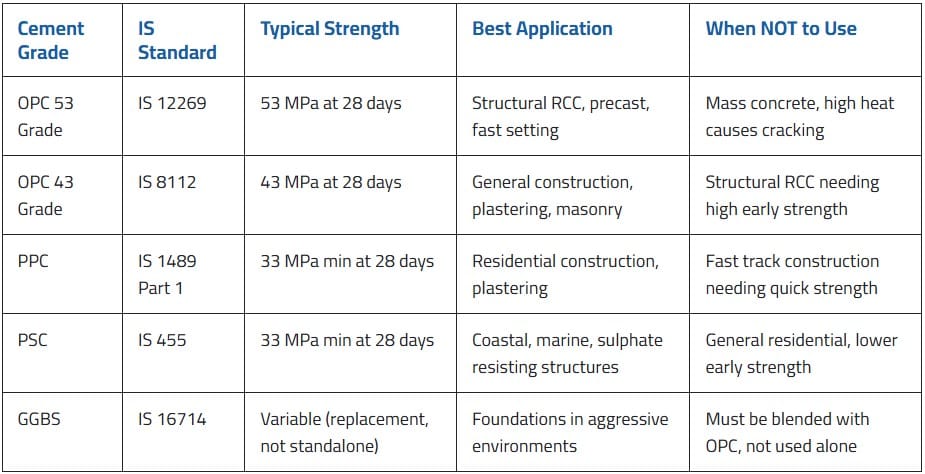
In coastal Gujarat (Navlakhi, Kutch), PSC or GGBS-blended cement resists chloride and sulphate attack better than OPC. Gujarat is IS 1893 Zone III-IV, so concrete below M20 is not acceptable under IS 456:2000. In summer and monsoon, PPC is preferred for its lower heat of hydration. Vasuki Cement manufactures OPC, PPC and PSC cement grades, plus GGBS, from its ISO 9001 plant at Morbi. See its PPC cement benefits for more.
Need cement for an upcoming project? Get a supply quote from Vasuki Cement →
TMT Bars: Choosing the Right Steel Reinforcement Grade
| TMT Grade | IS Standard | Yield Strength | Gujarat Recommendation |
|---|---|---|---|
| Fe 415 | IS 1786 | 415 MPa | Not recommended for new construction in Gujarat seismic zones |
| Fe 500 | IS 1786 | 500 MPa | Acceptable for low-rise residential in low-seismic areas |
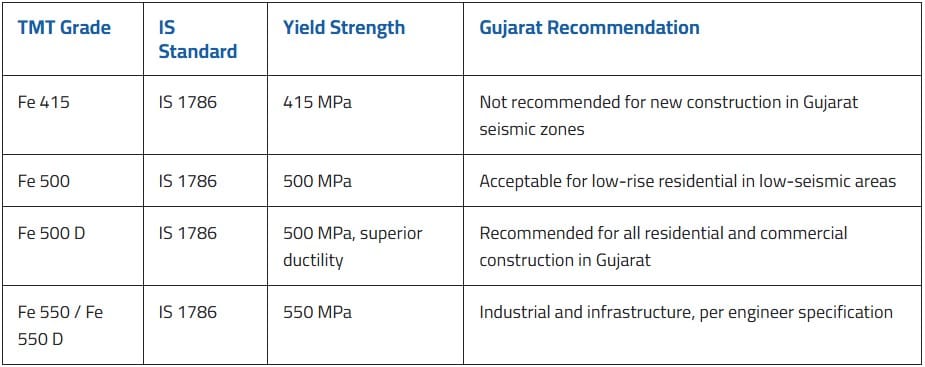
| Fe 500 D | IS 1786 | 500 MPa, superior ductility | Recommended for all residential and commercial construction in Gujarat |
| Fe 550 / Fe 550 D | IS 1786 | 550 MPa | Industrial and infrastructure, per engineer specification |
AAC Blocks vs Red Bricks: The Modern Walling Material
| Property | AAC Blocks | Red Clay Bricks | Fly Ash Bricks |
|---|---|---|---|
| Weight (density) | 650-1100 kg/m3 | 1800-2000 kg/m3 | 1700-1850 kg/m3 |
| Thermal insulation | Excellent | Poor | Moderate |
| Acoustic performance | STC 44, near soundproof | Poor | Moderate |
| Fire resistance | 4-hour rating | 1-2 hours | 1-2 hours |
| Construction speed | Up to 30% faster | Baseline | Similar to brick |
| Mortar consumption | Up to 66% less | Baseline | Baseline |
| Steel / cement saving | Up to 20% / 25% less | Baseline | Slightly less |
| Compressive strength | 3-5 MPa | 3.5-7 MPa | 4-6 MPa |
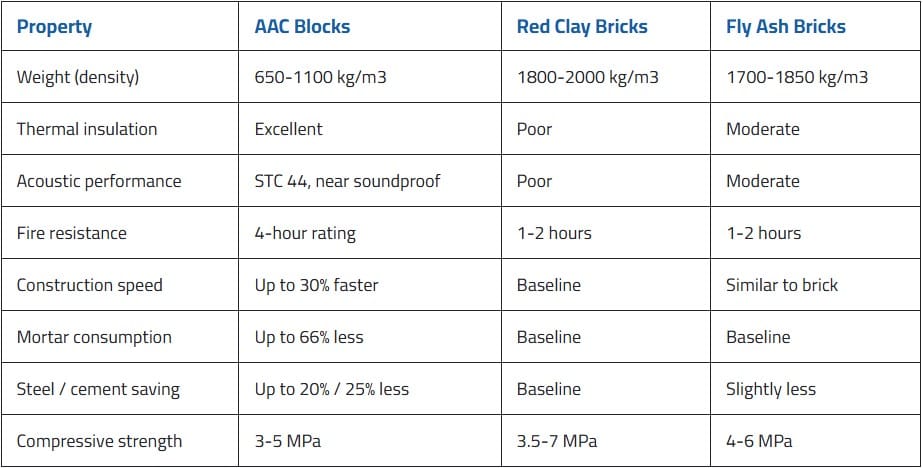
Use AAC for non-load-bearing walls above G+2, coastal buildings, and any project where speed matters. In Ahmedabad, Surat, and Rajkot summers above 42 degrees Celsius, AAC walls measurably cut interior temperature versus red brick. Vasuki Cement supplies AAC Blocks for construction projects across Gujarat.
Planning a wall system for a new build? Check AAC block availability →
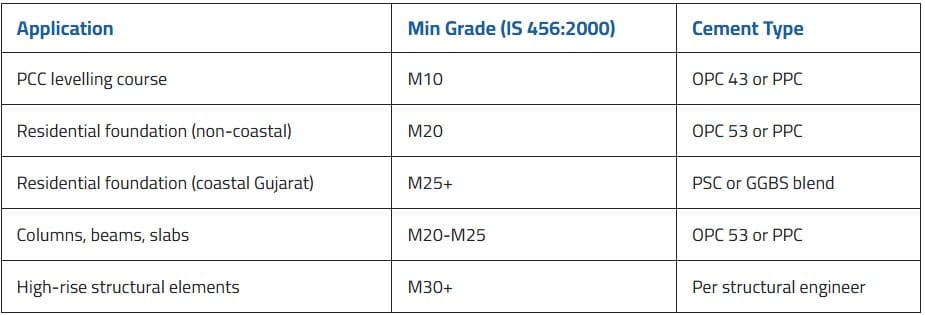
Concrete Aggregates and Mix Design
| Application | Min Grade (IS 456:2000) | Cement Type |
|---|---|---|
| PCC levelling course | M10 | OPC 43 or PPC |
| Residential foundation (non-coastal) | M20 | OPC 53 or PPC |
| Residential foundation (coastal Gujarat) | M25+ | PSC or GGBS blend |
| Columns, beams, slabs | M20-M25 | OPC 53 or PPC |
| High-rise structural elements | M30+ | Per structural engineer |
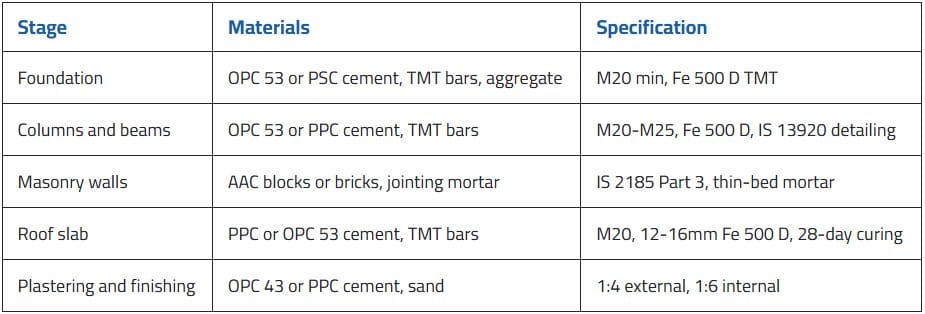
Building Construction Materials Checklist by Project Stage
| Stage | Materials | Specification |
|---|---|---|
| Foundation | OPC 53 or PSC cement, TMT bars, aggregate | M20 min, Fe 500 D TMT |
| Columns and beams | OPC 53 or PPC cement, TMT bars | M20-M25, Fe 500 D, IS 13920 detailing |
| Masonry walls | AAC blocks or bricks, jointing mortar | IS 2185 Part 3, thin-bed mortar |
| Roof slab | PPC or OPC 53 cement, TMT bars | M20, 12-16mm Fe 500 D, 28-day curing |
| Plastering and finishing | OPC 43 or PPC cement, sand | 1:4 external, 1:6 internal |
Five Construction Material Mistakes That Cost More to Fix Than to Avoid
- Using OPC in coastal or sulphate-prone soil instead of PSC or GGBS, the cost gap at specification stage is marginal compared to a rebuild.
- Cutting concrete grade at foundation stage: M15 is prohibited under IS 456:2000 for reinforced concrete, and the cost saved is under 2% of total construction cost.
- Buying TMT without checking the Mill Test Certificate (MTC), which confirms actual yield strength and composition of the batch.
- Using thick 10-12mm mortar joints with AAC blocks instead of the 2-3mm thin-bed mortar they need, which erases the thermal and mortar-saving advantage.
- Under-curing concrete: IS 456:2000 requires 7 days for OPC and 10-14 days for PPC or PSC. Under-cured concrete can lose up to 30% of its design strength.
Construction Material Trends in Gujarat for 2026
Red brick production bans in several districts are accelerating the shift to AAC blocks, already established in Ahmedabad, Surat, and Vadodara and now spreading to Rajkot and Morbi. GGBS and PPC are now mainstream for residential foundations for their durability and lower carbon footprint, see Vasuki Cement’s PPC for more. Contractors are also consolidating toward single-source suppliers of cement, TMT, and AAC blocks for better reliability, a model Vasuki Cement is built around.
Conclusion: Choose Building Construction Materials by Application, Not Price
The right building construction material is not the cheapest one, it is the one that meets the IS code specification for your design, exposure, and location in Gujarat. Cement grade, TMT specification, and walling material are interconnected, getting one right while compromising another still produces a weak building.
Get Building Construction Materials Delivered From One Trusted Source
Vasuki Cement manufactures OPC, PPC, PSC, and GGBS cement, TMT bars, and AAC blocks at one ISO 9001 certified plant in Morbi, so your project gets consistent quality and a single point of contact instead of multiple vendors to coordinate. Reach out to discuss supply for your next project in Gujarat.
Call: 88222 82888
Email: sales@vasukiinfra.com
Website: vasukiinfra.com/contact-us
FAQs
What are the main building construction materials?
Which cement is best for home construction in Gujarat?
Are AAC blocks better than red bricks?
What TMT grade should I use in Gujarat?
What is GGBS cement and when should I use it?
Looking for Cement Supply or Dealership?
Partner with us for consistent quality, competitive pricing, and dependable delivery.
Looking for Cement Supply or Dealership?
Partner with us for consistent quality, competitive pricing, and dependable delivery.