 88222 82888

How to Start a Vasuki Cement Dealership in 5 Simple Steps
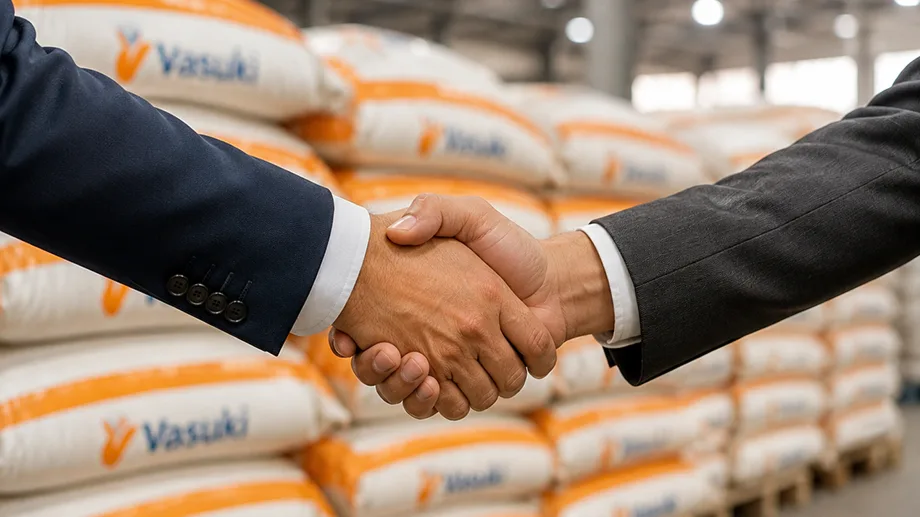
Gujarat accounts for a significant share of India’s construction activity, and that activity is not slowing. Infrastructure projects, residential housing, GIDC industrial expansion, and the state’s port-linked logistics corridors are all driving sustained demand for quality cement. A Vasuki Cement dealership puts you at the front of that demand, distributing what is fast becoming one of the best cement in Gujarat options for builders who want a locally manufactured, ISO-certified product.
A Vasuki Cement dealership is an authorised distribution partnership with Vasuki Cement Private Limited that lets a business function as a cement wholesaler that Gujarat builders and contractors can rely on, purchasing OPC, PPC, PSC and GGBS cement, along with AAC Blocks and TMT Bars, directly from the manufacturer at wholesale prices and selling to builders, contractors, and retail construction buyers in an assigned territory.
This guide walks through the 5-step process from application to activation, the requirements, the commercial opportunity, and how to apply. By the end, you will know exactly what becoming a Vasuki Cement dealer involves and how to start.
Why Choose a Vasuki Cement Dealership Over an Established National Brand
01
The Territory Opportunity That National Brands Can No Longer Offer
02
The Gujarat Manufacturer Advantage That Cuts Your Logistics Cost
A Vasuki Cement dealership in Gujarat benefits directly from where the plant sits. Vasuki Cement manufactures at Morbi in Saurashtra, Gujarat, so dealers get a shorter supply chain, faster delivery turnaround, and lower freight costs than brands manufacturing outside the state.
- Morbi’s road connectivity enables efficient deliveries across Gujarat, including high-growth construction hubs such as Dholera SIR, GIFT City, and the Ahmedabad-Gandhinagar region.
- Vasuki Global Industries, the parent company, manages its own logistics operations. This vertical integration reduces the supply chain vulnerabilities that third-party logistics-dependent manufacturers face.
03
Vertical Integration Means Price Stability and Supply You Can Depend On
Vasuki Global Industries Limited supplies the key raw materials, Clinker, Gypsum, Fly Ash, and Slag, to Vasuki Cement Private Limited through its own procurement vertical. Learn more about Vasuki Cement and the group structure behind it.
For a dealer, this matters commercially. When raw material costs spike for brands that source independently, their wholesale prices fluctuate. Vasuki’s integrated supply chain gives more stability in input costs and more predictable margins as a result.
The group brings over 20 years of experience in cement raw material procurement and logistics, starting as Vasuki Global Industries (Vasuki Enterprise, 2004, later a partnership firm from 2012). The cement manufacturing subsidiary is new, but the group’s market knowledge is not.
04
ISO Certifications That Open Government and Institutional Markets
A Vasuki Cement dealership also comes with certifications that matter to larger buyers. Vasuki Cement holds three ISO certifications: ISO 9001:2015 (Quality Management System), ISO 45001:2018 (Occupational Health and Safety Management), and ISO 14001:2015 (Environmental Management System).
For dealers pursuing government contracts, infrastructure projects, and institutional buyers such as hospitals, educational institutions, and public sector undertakings, certified cement is often a procurement requirement. As a Vasuki dealer, you can supply to these higher-margin segments. BIS (Bureau of Indian Standards) compliance for OPC and PPC grades ensures the product quality consistency that builders and structural engineers require.
The 5-Step Process to Start Your Vasuki Cement Dealership
01
Step 1: Assess Your Location and Understand Local Market Demand
If you want to become a cement dealer in Gujarat, this is where it starts, understanding the ground reality of your specific territory before you approach any manufacturer.
- Evaluate construction activity in your territory: count ongoing residential projects, infrastructure works, and GIDC activity within a practical delivery radius of your proposed storage location.
- Identify the existing cement brands local contractors and builders buy, and understand what drives their preference, price, availability, credit terms, or quality reputation.
- Check whether a Vasuki Cement dealer already operates in your area. Someone searching cement dealer near me in your district will likely find them first, so sub-dealer or retail opportunities may still be open. The sales team confirms territory status on contact.
- Check road access to your storage facility. Cement delivery needs trucks with 9 to 12 tonne capacity, so ensure the site allows vehicle access for unloading.
02
Step 2: Prepare Your Business Documentation and Storage Facility
Applications require standard business documentation. Prepare the following before you submit:
- GST registration certificate (GSTIN)
- PAN card (proprietorship) or company PAN and incorporation documents (partnership or Pvt Ltd)
- Aadhaar card or voter ID of the proprietor or directors
- Bank account details and a cancelled cheque
- Business address proof: electricity bill, rent agreement, or ownership document for commercial premises
- Storage space documentation: minimum 500 sq ft covered storage area, accessible by delivery trucks
If you do not yet have a registered business, GST registration is the first step. It requires a business address, PAN, Aadhaar, and bank account, and most registrations in Gujarat are processed within 7 to 10 working days online.
Your storage facility should keep cement off the floor, on wooden pallets or platforms, in a dry environment protected from rain and humidity. This matters both for product quality and for meeting dealer standards.
03
Step 3: Submit Your Dealership Enquiry to Vasuki Cement
This is the step that actually starts your Vasuki Cement dealership application. Vasuki Cement accepts dealership enquiries through three channels:
- Online form: visit vasukiinfra.com, scroll to the ‘Looking for Cement Supply or Dealership?’ section, select the Dealership tab, and fill in your name, email, phone, pincode, state, city, and message.
- Phone: call the Vasuki Cement sales team directly at 88222 82888.
- Email: send your enquiry to sales@vasukiinfra.com with your name, location, business type, storage capacity, and a brief note on the construction market in your area.
In your enquiry, include your proposed territory (district or taluka), the type of buyers you will serve (retail hardware, contractors, builders, institutional), your storage capacity, and any existing building materials business you operate. A specific, detailed enquiry gets a faster and more productive response than a generic one.
To submit your Vasuki Cement dealership application, contact Vasuki Cement through the dealership form, or call 88222 82888 directly.
04
Step 4: Complete the Evaluation and Agreement Process
After your enquiry, a sales representative will contact you to discuss territory boundaries, expected volume commitments, security deposit, credit terms, and delivery logistics from the Morbi plant to your location.
You may be asked for additional documentation or a visit to your proposed storage facility, standard practice that confirms you have the infrastructure to maintain product quality.
Security deposit typically ranges from Rs. 1 lakh to Rs. 3 lakh depending on brand and territory, confirm the specific figure with the Vasuki sales team. Most manufacturers return it with applicable interest when the dealership terminates in good standing.
Review the agreement carefully before signing: territory boundaries, minimum purchase commitments, price revision terms, credit period, and the return policy for damaged goods. If any clause is unclear, take legal advice first.
05
Step 5: Place Your First Order and Launch Your Dealership
Once the agreement is signed and the deposit paid, place your initial stock order. Starting with 50 to 100 bags per grade is a manageable inventory that lets you serve early customers without over-committing capital before your sales pipeline is established.
Vasuki manufactures OPC, PPC, PSC and GGBS cement:
- OPC is ideal for general construction and structural work.
- PPC is suited for residential construction and plastering due to its reduced heat of hydration.
- PSC is for marine, coastal, and industrial structures that need high sulphate resistance.
- GGBS cement is a reliable choice for sustainable construction and is widely used across different types of projects.
Set up physically: print dealer identification for your shop, tell your contractor and builder contacts you now carry Vasuki Cement, and register with local contractors’ associations. Vasuki also manufactures AAC Blocks and TMT Bars, worth stocking alongside cement for full-project buyers.
The sales team supports your launch with marketing materials, technical sheets, and ongoing supply coordination. Use these resources from day one.
Investment Required and Dealer Margin Structure for a Vasuki Cement Dealership
| Investment Component | Industry Benchmark Range | Notes |
|---|---|---|
| Security deposit to manufacturer | Rs. 1 lakh to Rs. 3 lakh | Refundable on termination in good standing. Confirm exact figure with Vasuki sales team. |
| Initial stock purchase | Rs. 2 lakh to Rs. 5 lakh (50 to 150 MT) | Depends on bag count and grades selected. Start lean and scale as orders come in. |
| Storage facility setup | Rs. 50,000 to Rs. 1.5 lakh | Pallets, basic infrastructure, signage. Higher if facility rental is included. |
| Business registration and GST | Rs. 5,000 to Rs. 15,000 | If not already registered. Includes professional fees for a CA or registration agent. |
| Working capital buffer | Rs. 1 lakh to Rs. 2 lakh | For operating costs during the first 60 to 90 days while receivables build. |
| Total estimated investment | Rs. 4.5 lakh to Rs. 12 lakh | Varies by territory size, stock volume, and facility status. |
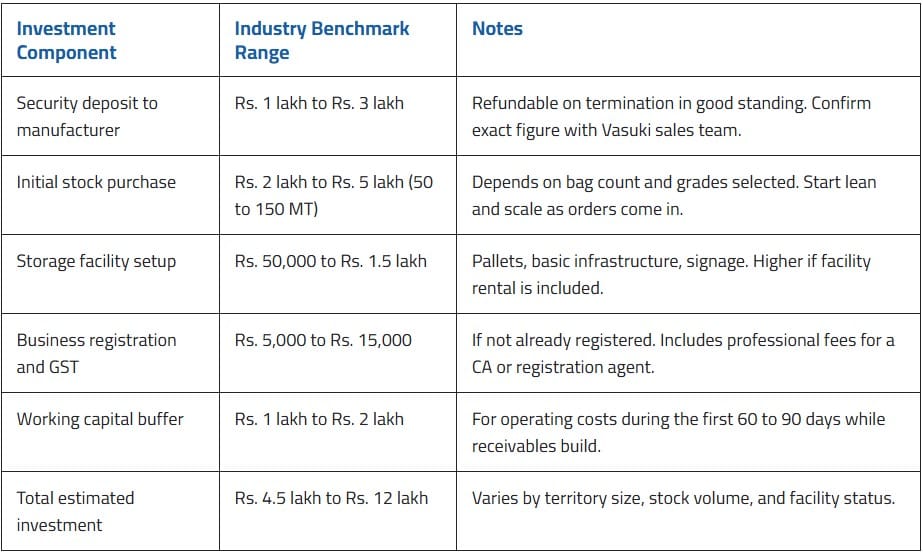
Important: all investment figures above are industry benchmarks for cement dealerships in India. The specific security deposit, minimum order quantity, and credit terms for a Vasuki Cement dealership must be confirmed directly with the Vasuki Cement sales team at 88222 82888 or sales@vasukiinfra.com. Figures may vary by territory and dealership type.
What a Cement Dealer Earns: Understanding the Margin Structure
Margin is usually the deciding factor in whether a Vasuki Cement dealership makes financial sense. Cement dealers in India typically earn an 8 to 10% margin on the retail selling price. For a 50 kg bag priced at Rs. 350 to Rs. 400, an 8% margin represents Rs. 28 to Rs. 32 per bag.
On a monthly volume of 500 MT, roughly 10,000 bags, that is a gross margin of Rs. 2.8 to Rs. 3.2 lakh before storage, transport, and operating costs. Volume bonuses can supplement this for dealers who consistently meet monthly targets; confirm the specific scheme with Vasuki during the agreement stage.
Credit terms to buyers are the main working capital variable. Extending credit increases volume but needs a larger buffer, so new dealerships are advised to start with cash-and-carry or short-credit customers and extend credit selectively as relationships build.
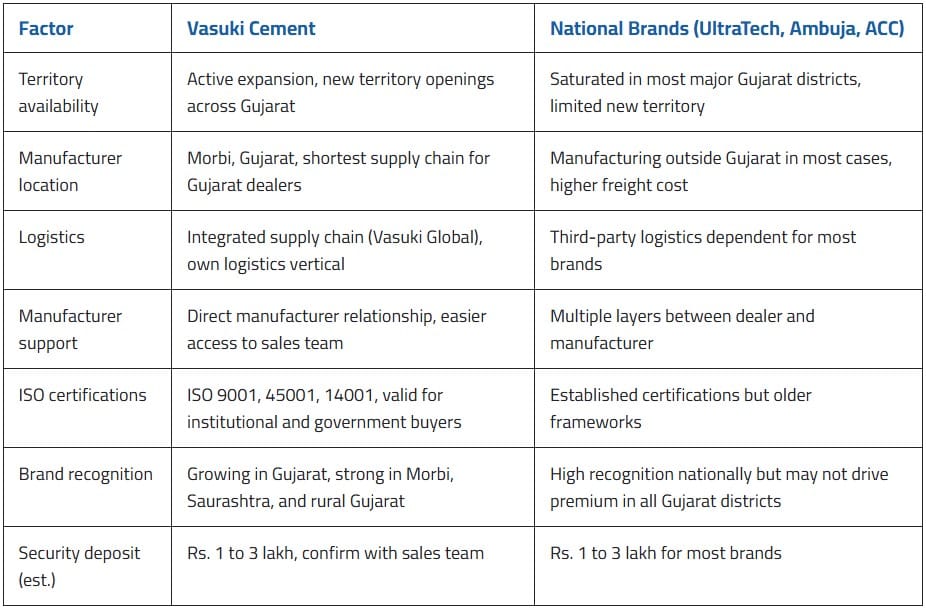
Vasuki Cement vs National Brands as a Dealership Partner
UltraTech, Ambuja, and ACC are established, well-recognised brands. This dealership offers a different set of advantages worth weighing against that recognition.
| Factor | Vasuki Cement | National Brands (UltraTech, Ambuja, ACC) |
|---|---|---|
| Territory availability | Active expansion, new territory openings across Gujarat | Saturated in most major Gujarat districts, limited new territory |
| Manufacturer location | Morbi, Gujarat, shortest supply chain for Gujarat dealers | Manufacturing outside Gujarat in most cases, higher freight cost |
| Logistics | Integrated supply chain (Vasuki Global), own logistics vertical | Third-party logistics dependent for most brands |
| Manufacturer support | Direct manufacturer relationship, easier access to sales team | Multiple layers between dealer and manufacturer |
| ISO certifications | ISO 9001, 45001, 14001, valid for institutional and government buyers | Established certifications but older frameworks |
| Brand recognition | Growing in Gujarat, strong in Morbi, Saurashtra, and rural Gujarat | High recognition nationally but may not drive premium in all Gujarat districts |
| Security deposit (est.) | Rs. 1 to 3 lakh, confirm with sales team | Rs. 1 to 3 lakh for most brands |
Common Mistakes New Cement Dealers Make and How to Avoid Them
01
Underestimating Storage Requirements and Cement Shelf Life
Cement has a shelf life of about 3 months from manufacture when stored correctly, so buying more stock than you can sell in 60 to 90 days risks deterioration.
- Store on wooden pallets, never directly on the floor, in a dry, covered facility protected from rain and humidity.
- Stack bags no more than 10 to 12 high to prevent crushing damage to lower bags.
02
Extending Too Much Credit Too Early
03
Ignoring Product Knowledge
Dealers who can explain the difference between OPC, PPC, PSC and GGBS to a civil engineer or project manager earn more trust and close larger orders than those who only know ‘we have cement’.
OPC suits general construction and structural RCC work. PPC suits residential construction and plastering, with better durability in moist environments. PSC suits marine, coastal, and industrial projects needing sulphate resistance. GGBS suits sustainable construction and applications that require improved material performance. Vasuki’s technical team provides product specification sheets with your documentation; read them before your first sales conversation.
Start Your Vasuki Cement Dealership Today
The Gujarat construction market is one of the strongest in the state’s history, with years of growth ahead. A Vasuki Cement dealership gives you direct access to a manufacturer with an integrated supply chain, a growing brand presence, ISO-certified products, and an actively expanding dealer network with territory still available.
The 5 steps are clear: assess your market, prepare your documentation, submit your enquiry, complete the agreement, and launch. Most dealerships take 2 to 4 weeks from first contact to first order.
Ready to start your Vasuki Cement dealership? The sales team is actively looking for dealer partners across Gujarat. Submit your enquiry today: Online form at vasukiinfra.com (Dealership tab), Call or WhatsApp 88222 82888, Email sales@vasukiinfra.com, or Visit Office No. B1008 and B1009, Sankalp Square 3B, Beside Taj Hotel, Sindhu Bhavan Road, Shilaj, Ahmedabad 380059.
FAQs
How do I apply for a Vasuki Cement dealership?
You can apply through three channels: fill in the Dealership enquiry form at vasukiinfra.com (select the Dealership tab in the ‘Looking for Cement Supply or Dealership?’ section), call 88222 82888, or email sales@vasukiinfra.com. Include your name, location, pincode, type of buyers you will serve, and your storage capacity.
What is the investment required for a Vasuki Cement dealership?
Total investment for a cement dealership typically ranges from Rs. 4.5 lakh to Rs. 12 lakh, covering security deposit (Rs. 1 to 3 lakh, refundable), initial stock, storage setup, and working capital. Specific figures must be confirmed with the sales team at 88222 82888, as they vary by territory and agreement type.
What is the dealer margin for Vasuki Cement?
Cement dealer margins in India typically range from 8 to 10% of the retail selling price. Vasuki Cement’s specific margin structure and volume incentive scheme are discussed during the dealership agreement process, so contact the sales team for current terms.
What space is required for a cement dealership?
A minimum of 500 sq ft of covered, dry storage space accessible by delivery trucks is required for most cement dealerships. The space must allow for palletised storage, bags off the floor, and stacking of 10 to 12 bags high. Larger territories typically require 1,000 sq ft or more.
What is the difference between OPC, PPC, PSC and GGBS cement?
OPC (Ordinary Portland Cement) is used for general structural and RCC work. PPC (Portland Pozzolana Cement) is used for residential construction and plastering, offering better durability in moist environments. PSC (Portland Slag Cement) is used for coastal, marine, and industrial projects requiring sulphate resistance. GGBS (Ground Granulated Blast Furnace Slag) is used in sustainable construction and applications that benefit from improved material performance.
Looking for Cement Supply or Dealership?
Partner with us for consistent quality, competitive pricing, and dependable delivery.
Looking for Cement Supply or Dealership?
Partner with us for consistent quality, competitive pricing, and dependable delivery.